
The Chatterbox: Inside Andy's Contemporary Self-Build on a 14-Acre Farm in Suffolk
Produced & Written by Dan Burge | 03 June 2026
HomeInspire visited Andy's extraordinary self-build on a 14-acre former dairy farm near Southwold in Suffolk - a project a decade in the making that transformed a completely derelict, overgrown site into one of the most considered contemporary homes we have ever featured. Three barn forms, a glass entrance hall that frames the countryside in every direction, a sunken garden, a ground source heating system buried beneath the fields, and five double bedrooms finished with the kind of detail that only comes from someone who had years to think about every decision.
Finding the Site: A Derelict Farm at Auction
A Familiar Landscape, an Unfamiliar Opportunity
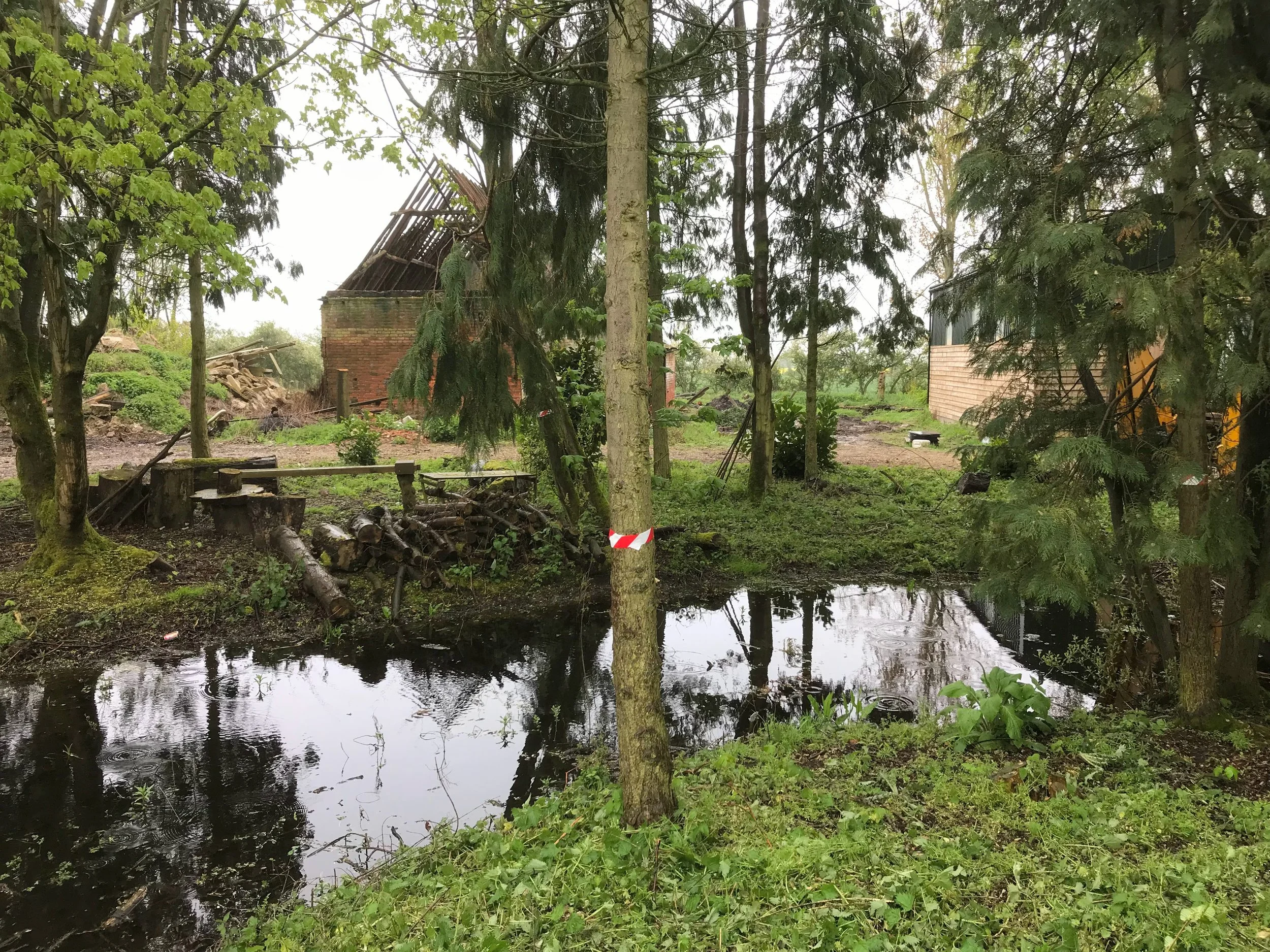
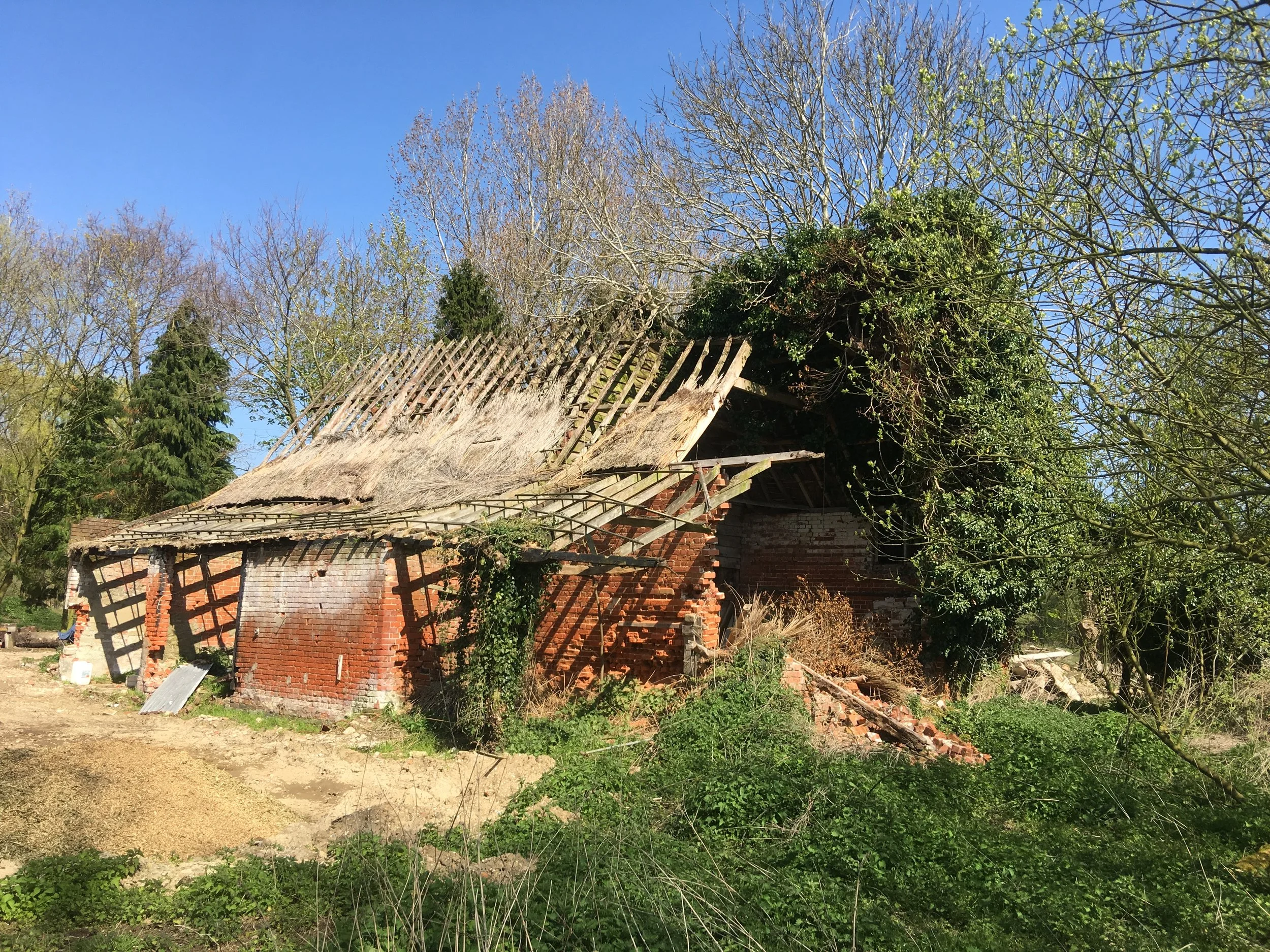
Andy grew up in Suffolk, a few miles from the site he eventually bought. After many years living in Europe, he found himself looking for a home to return to — somewhere that felt right in this particular landscape, in this particular part of the world. He looked at a number of houses but none quite matched what he had in mind. Then he found Waterloo Farm. "Prior to the auction I came down here — it was so overgrown. Completely overgrown. Unmanaged for almost 40 years." What most people would have walked away from, Andy saw as precisely the right kind of blank canvas.
Buying Without Water, Without Electricity, Without a Plan
The farm came with no mains water connection, no electricity, and land that had been left entirely to its own devices for four decades. After securing the site at auction, Andy began living on it — camping, essentially. "We were really living in almost campfire conditions." It was a radical beginning to what would become a decade-long project, but the time spent on the land before a single drawing was produced shaped every decision that followed.
Three Years Just to Decide Where to Build
The first and most fundamental question — where on the 14 acres to place the house — took three years to answer properly. The original farmhouse had stood close to the road and was long gone. A planning permission for a replacement dwelling already existed on the site, but it didn't feel right. "We worked more towards the central area of the farm buildings. So that was perhaps the most important decision — it was probably three years where to build it." The answer, when it came, was to build within the central farmyard, using the existing historic structures as the organisational framework for everything that followed.
The Design Brief: Modern, Transparent and Rooted in Place
Something That Belonged to This Landscape
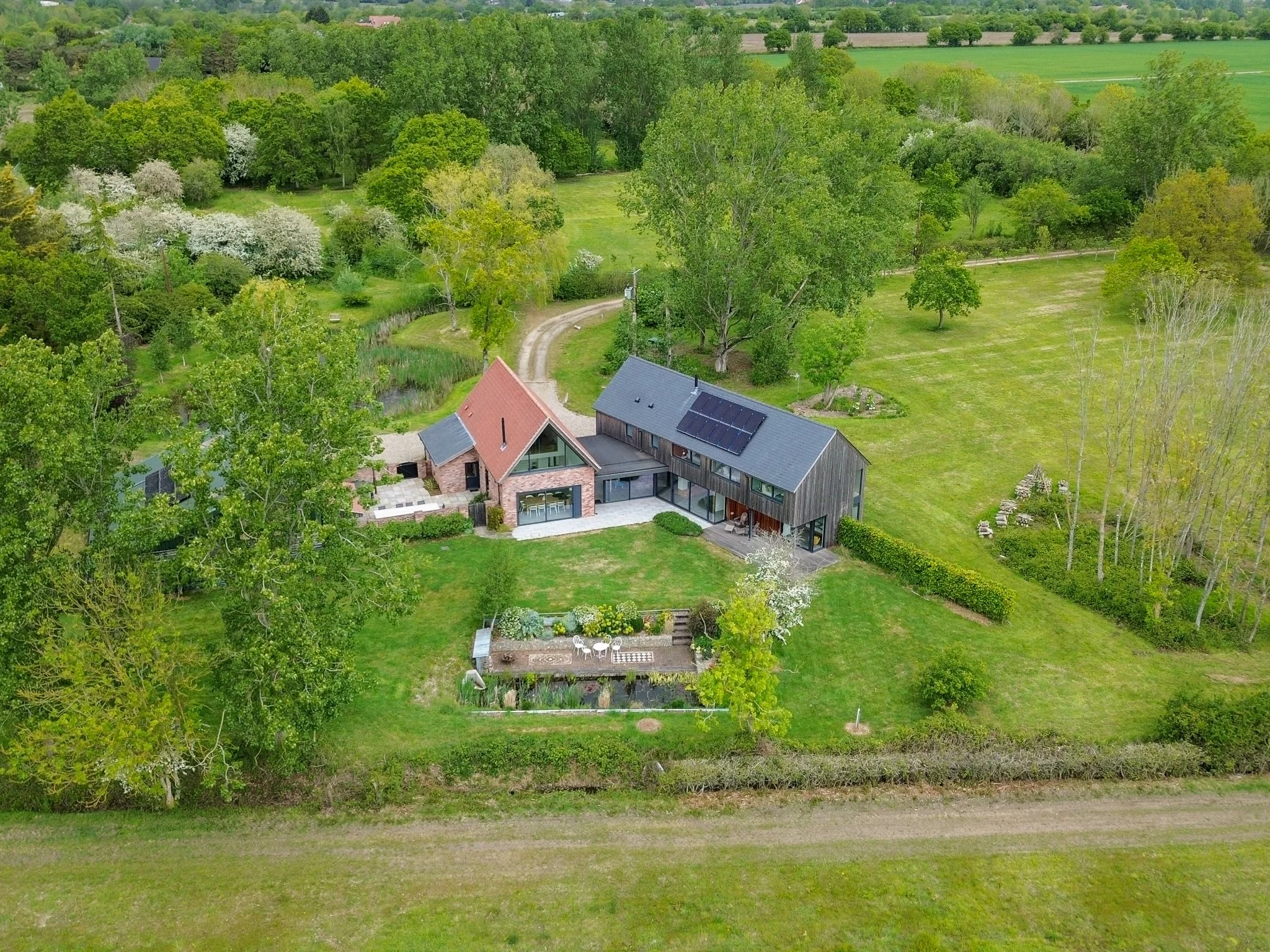
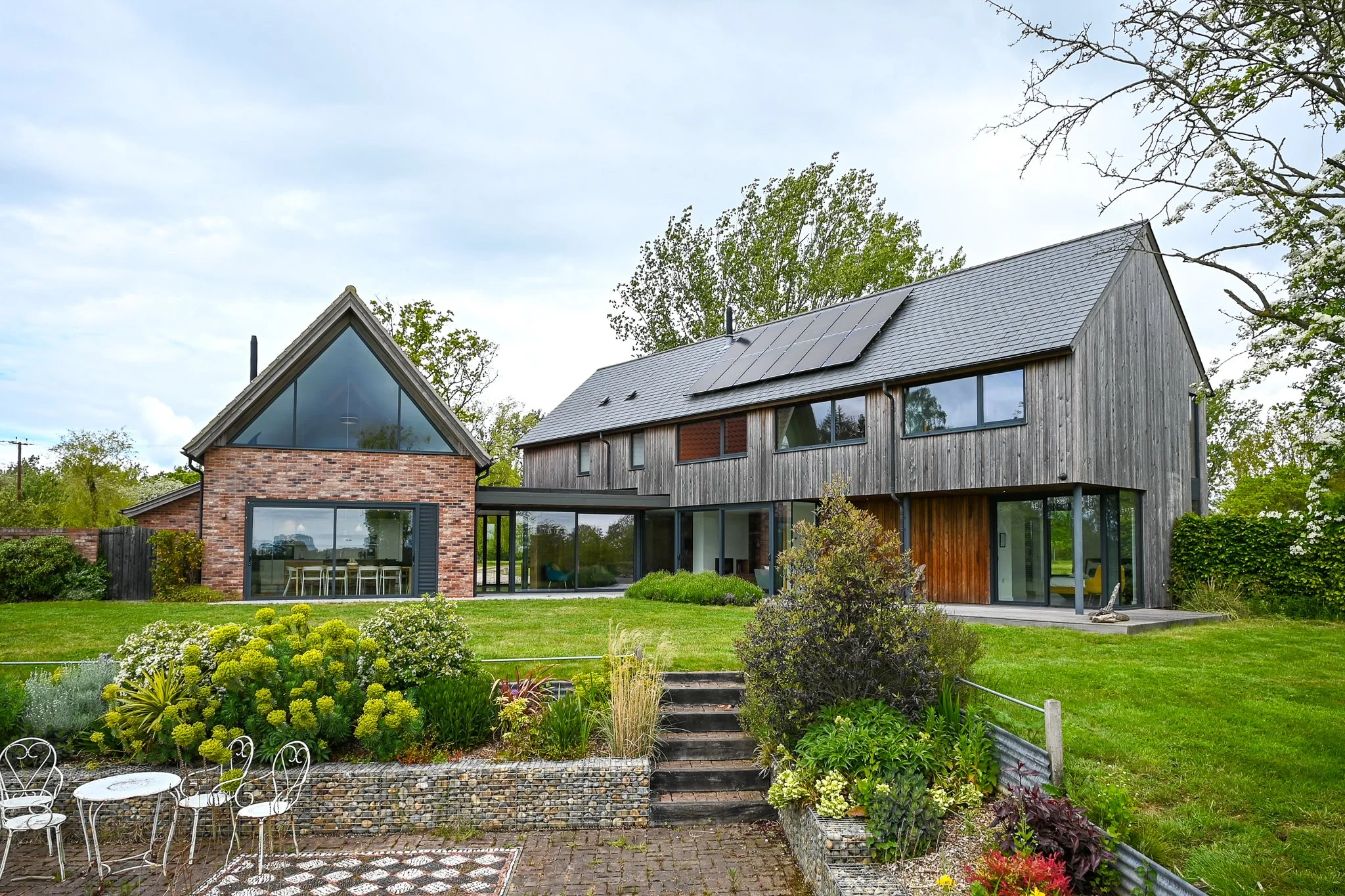
From the outset, Andy was clear about one thing: the building needed to feel as though it had always been here. "I was really looking at building something that fitted into the landscape of this part of the world." That meant taking cues from the agricultural vernacular — the pitched forms, the mix of brick and timber, the honest use of materials — rather than imposing something alien onto a sensitive rural setting.
Modern Without Apology
The second strand of the brief was equally clear. Andy did not want a faux-period house. "It's easy enough to buy houses with a little bit of history from two, three hundred years ago. They were very beautiful. But I didn't want something like that. I wanted something transparent, that brought in new building technologies — underground heating as opposed to drafty windows." The house was to be modern in its performance, in its openness, and in its relationship to the landscape — even while it spoke the language of the farm buildings around it.
Working Remotely with the Right Designer
The third challenge was practical: Andy was based in Europe throughout much of the design and construction process. "I was based in Europe at the time and I had to find a designer who I could kind of work on a remote basis with — someone I really liked their work." The working relationship they developed proved excellent, and the results demonstrate what a sustained, unhurried collaboration between a homeowner and a designer can produce when both parties are given the time to get it right.
Arriving at the House: The Approach and the Farmstead
Hidden from the Road
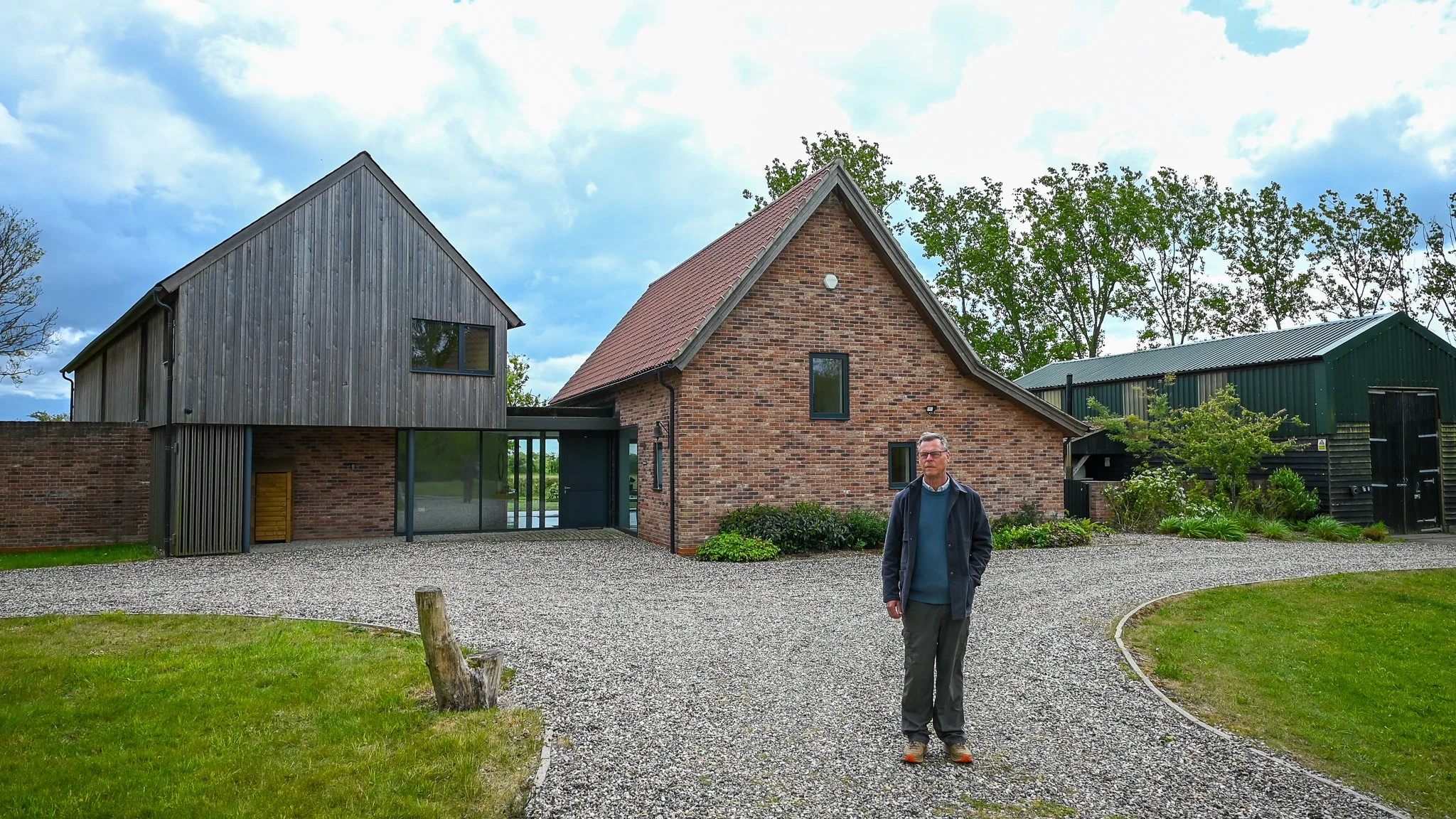
The experience of arriving at The Chatterbox is carefully managed. From the road, nothing announces itself. You turn in through a gate and follow a long gravel path surrounded by mature trees and hedgerows. "You don't really ever notice the house. It allows itself to be hidden within the nature as much as I think is possible." Only as you emerge into the farmyard do you suddenly understand the scale and ambition of what has been built here.
Three Barn Forms, One Coherent Composition
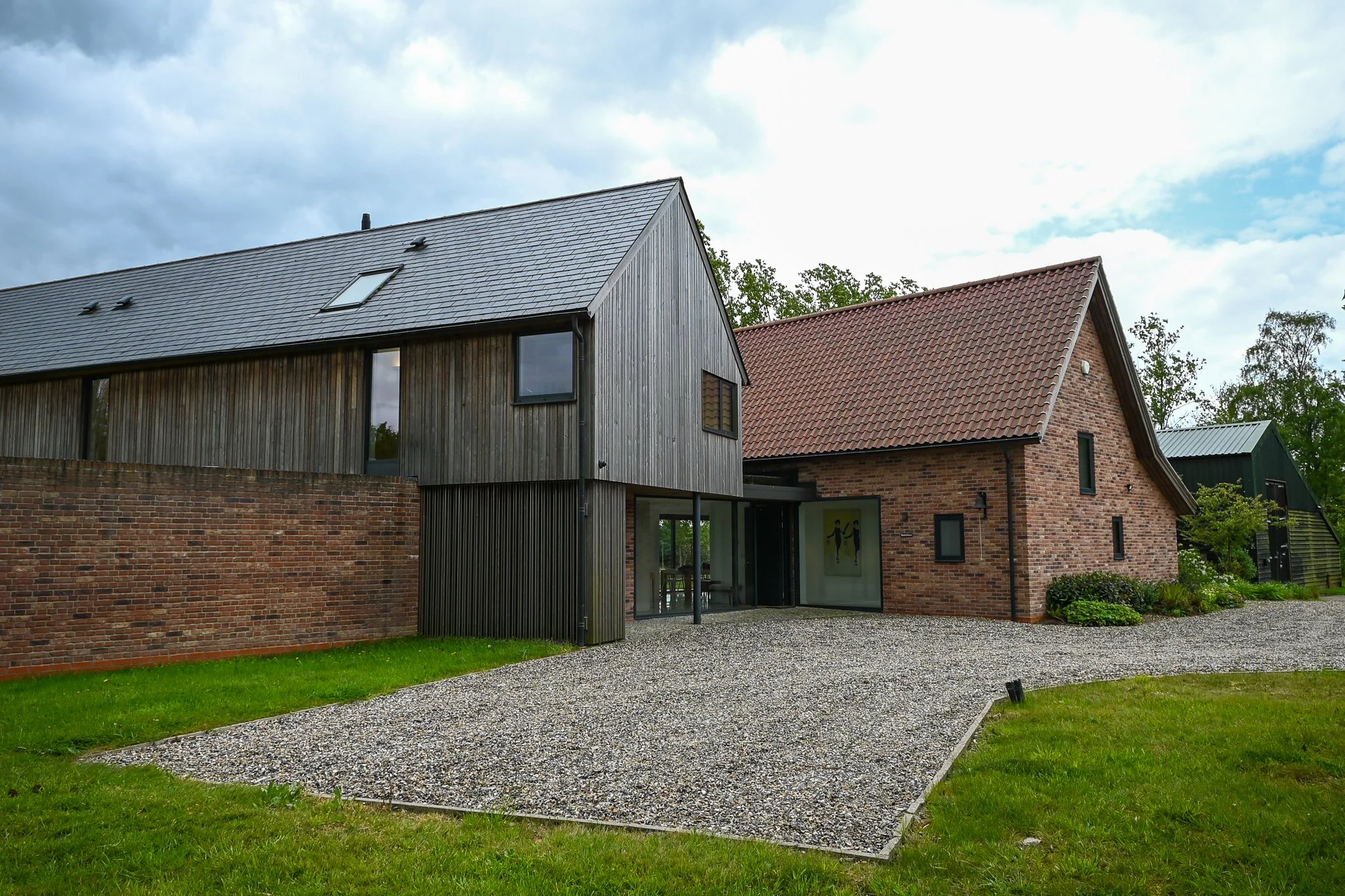
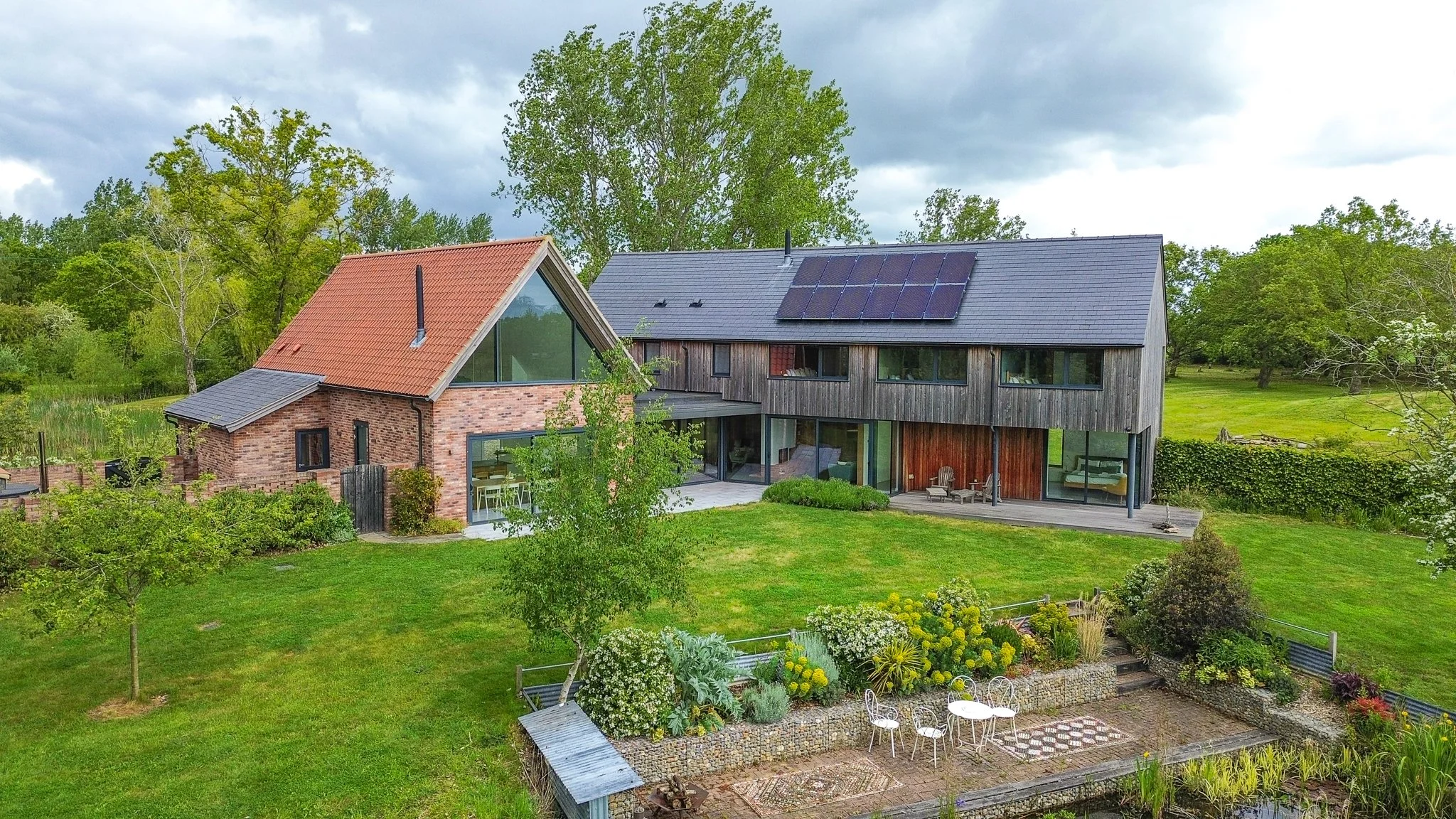
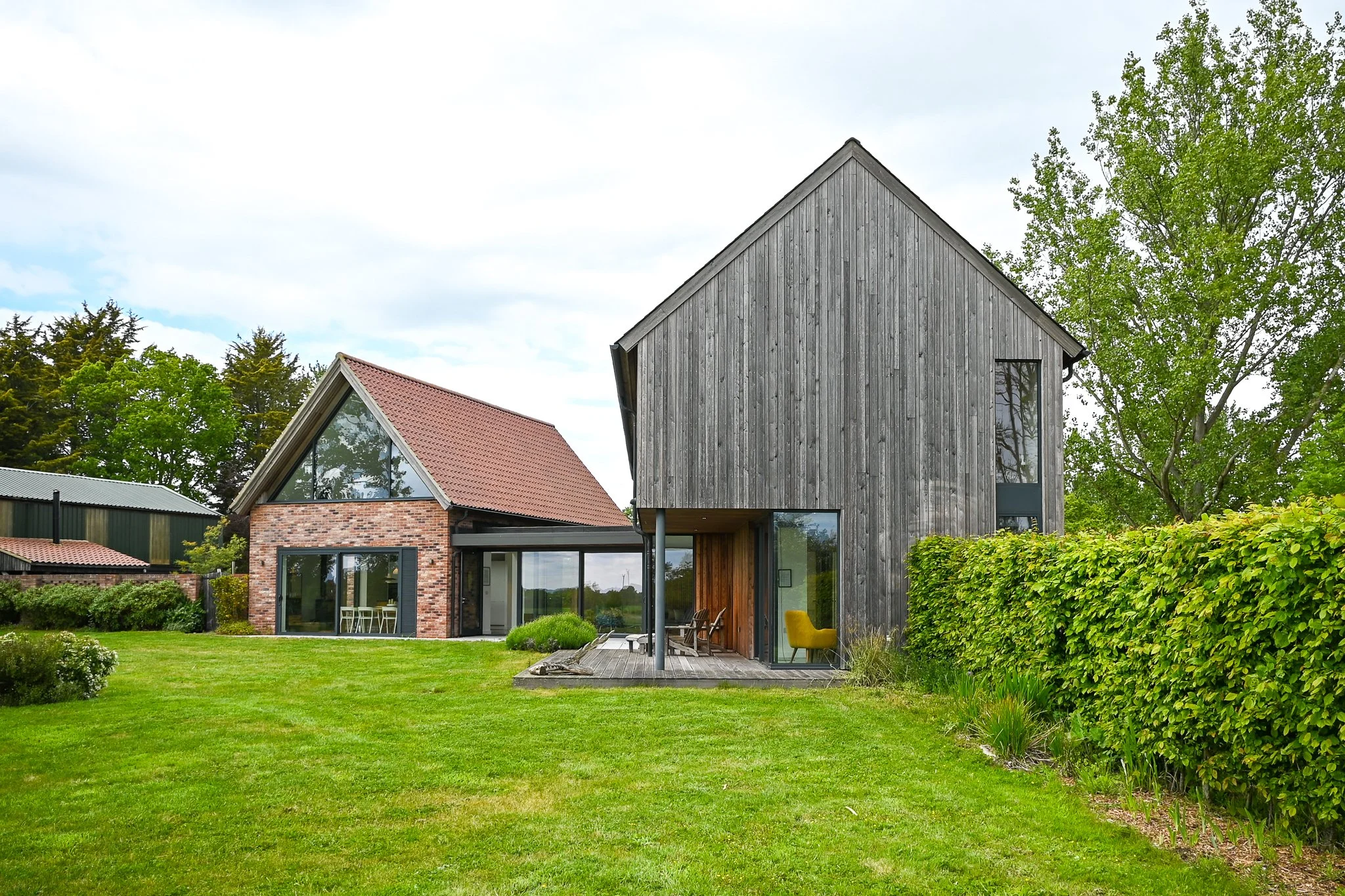
The farmyard presents three distinct structures, each with its own character, together forming a composition that reads as something that has grown organically over time — because, in a sense, it has. "You have a traditional 1970s Dutch barn — the first thing I renovated and was extremely challenging over the last ten years. Then you have a Flemish barn dating to about 1800 or so. I couldn't believe it still had its roof and was still standing." These two historic structures anchor the composition; the new larch-clad accommodation block connects and completes it. Between everything sits a glass entrance hall — essentially transparent — so that views pass straight through the building from the approach to the landscape beyond.
The Philosophy of the Farmstead
The layering of materials and periods is entirely intentional. "Farms evolve — they're built and added to over time. And that's what we've tried to do with this. Different materials, from the wavy edge larch of the accommodation block to the brick work of the old Flemish barn — they're very similar to how farms actually were." The result is a building that feels discovered rather than designed, which is one of the highest compliments you can pay to a self-build of this ambition.
The Entrance Hall and Ground Floor: Open, Connected and Flooded with Light
A Glass Hall That Frames the Fields
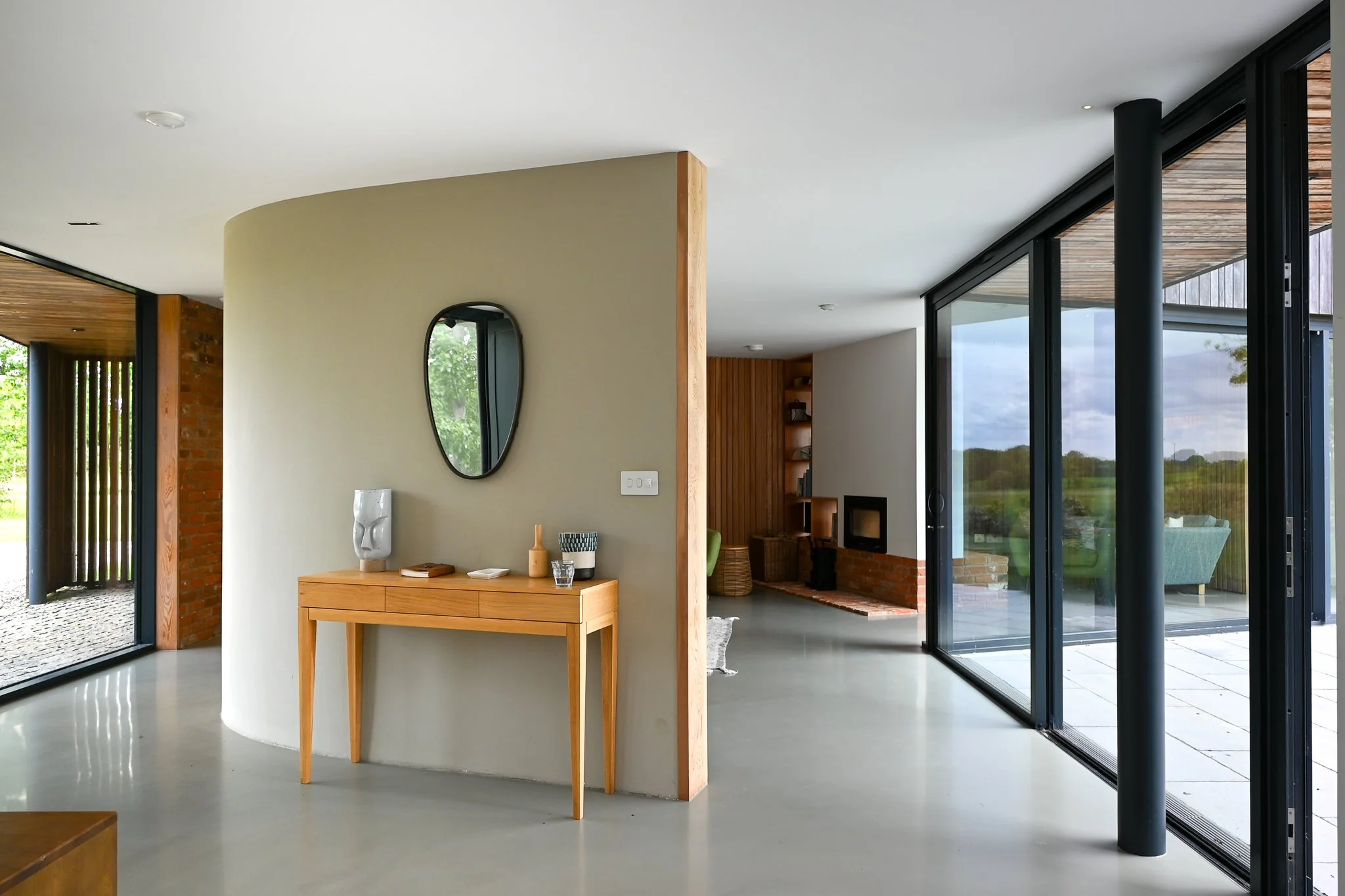
The entrance to the house is a revelation. The glass hall connects the accommodation block and the kitchen wing and reads, from outside, as almost entirely transparent. "As you approach the house you suddenly see the accommodation block and the kitchen area connected into one. So when you walk in, it's incredibly open. The fields and the landscape are providing all the form and structure of the space." Visitors can see through the house in every direction, with the landscape the constant backdrop.
The Poured Resin Floor
One of the most quietly significant decisions in the whole project is the floor. A seamless poured resin runs across the entire ground floor — no thresholds, no level changes, no breaks. "Originally, I was going to use poured concrete, but my designer suggested otherwise and I'm very pleased that she did." The material contributes to the sense of the ground floor as a single, continuous space, and Andy notes that guests who are unfamiliar with the layout will often find themselves moving from room to room without quite understanding how — discovering the house rather than navigating it.
HomeInspire Downloads
Download Our Complete Renovation Handbook
A step-by-step guide to planning, designing, and delivering your dream home.
Planning your first renovation doesn’t have to be overwhelming. This 62-page step-by-step eBook guides you through every stage - from budgeting and planning to design, permissions, and finishing touches. Packed with expert advice, checklists, and cost guides, it helps you avoid mistakes, stay on track, and bring your dream home to life.
The Kitchen and Dining Room: The Heart of the House
A German Kitchen Under a 6.5-Metre Apex
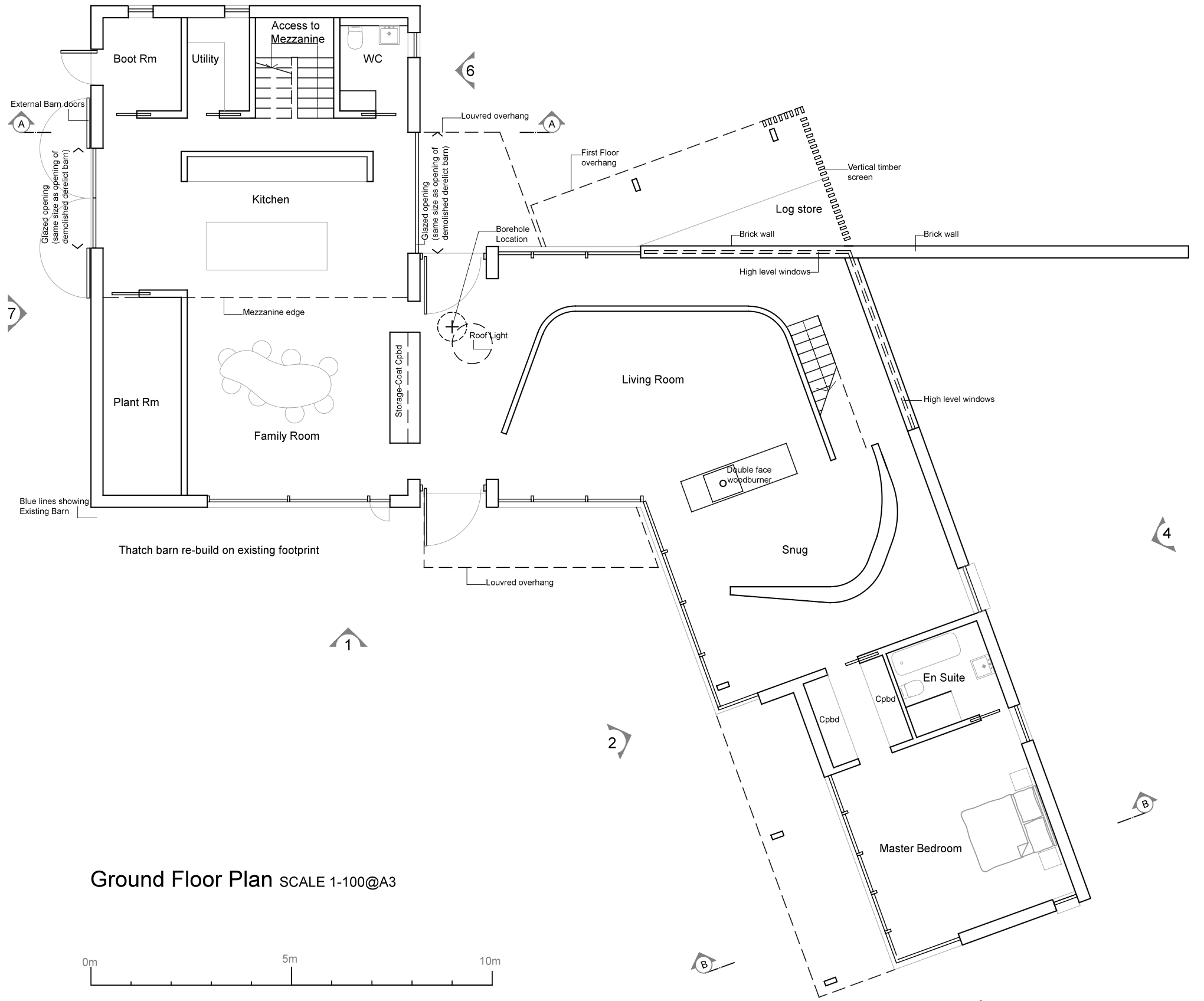
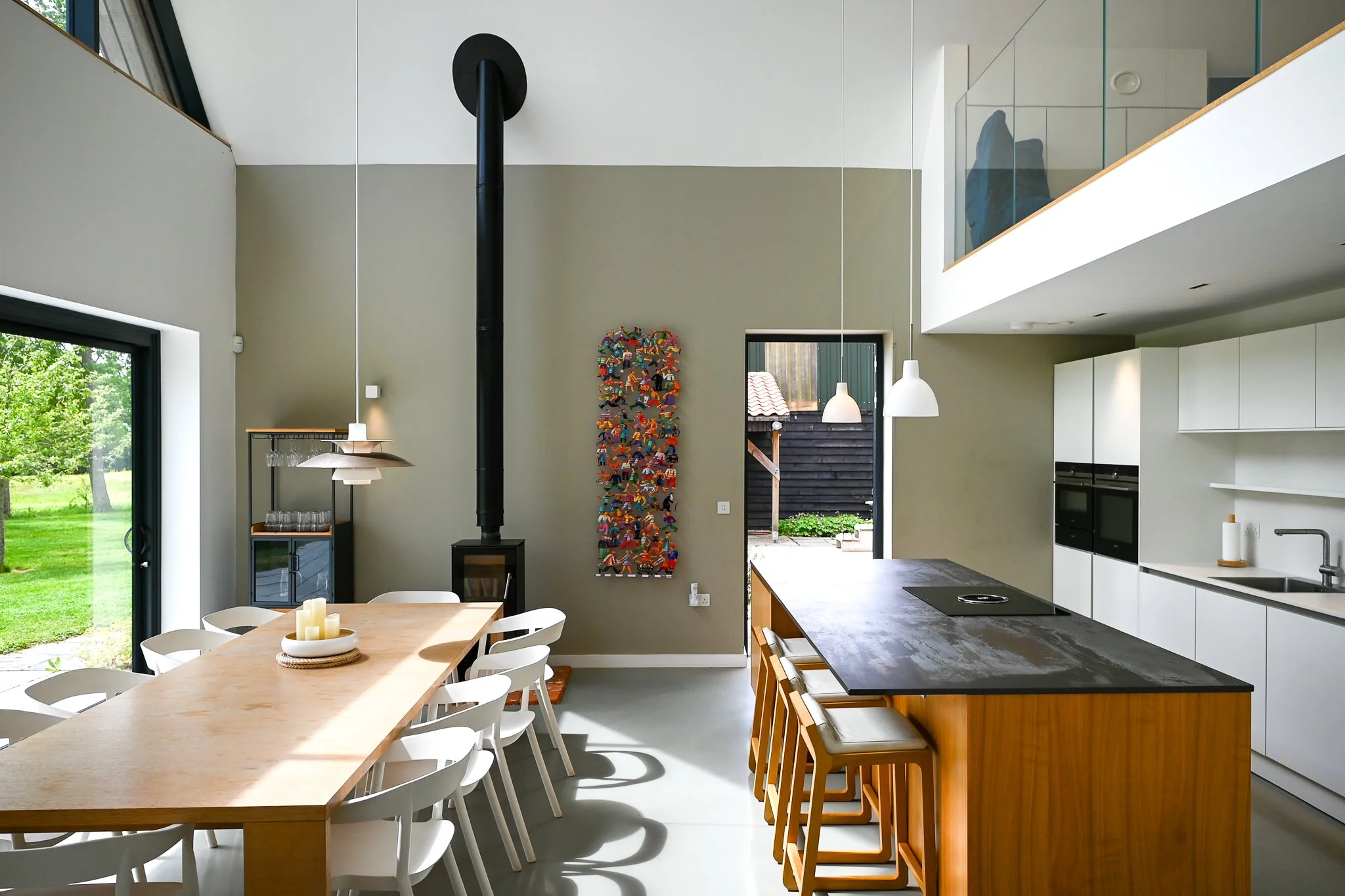
The kitchen and dining room occupies the exact footprint of the original Flemish barn — and the barn's geometry is the kitchen's defining feature. The ceiling rises to 6.5 metres at the apex, with the original barn form expressed in a dramatic triangular window that frames the sky. "We knew we wanted to keep that barn-like window and obviously the patio with the landscape in the background." The space is generous, open, and social. "As a family, we all cook. It's a great talking space."
A Specialist German Kitchen
The kitchen itself was specified through a specialist who, as Andy explains, "specialised in German kitchens." It was manufactured in Germany, shipped over, and fitted on site. The ceramic worktop — a material Andy describes as "very special and quite unique" — runs throughout, accompanied by a Bora unit for extraction, which handles the cooking without the need for an overhead hood and keeps the lines of the kitchen clean and uninterrupted beneath that extraordinary ceiling.
The Mezzanine TV Room
One of the most inventive spatial moves in the house is the mezzanine TV room, inserted above the utility spaces and looking down over the kitchen below. "It was a fantastic idea actually — of building the television up there. As a family, we wanted to have a space that could be placed in front of the television, but then sort of placed almost out of the way for those who want to come up and be connected to the group but also be isolated and put away so people can have the conversations." The mezzanine resolves the perennial tension between the communal and the private without sacrificing either.
The Living Room, Snug and Courtyard
Douglas Fir, a Double-Sided Wood Burner and the Snug
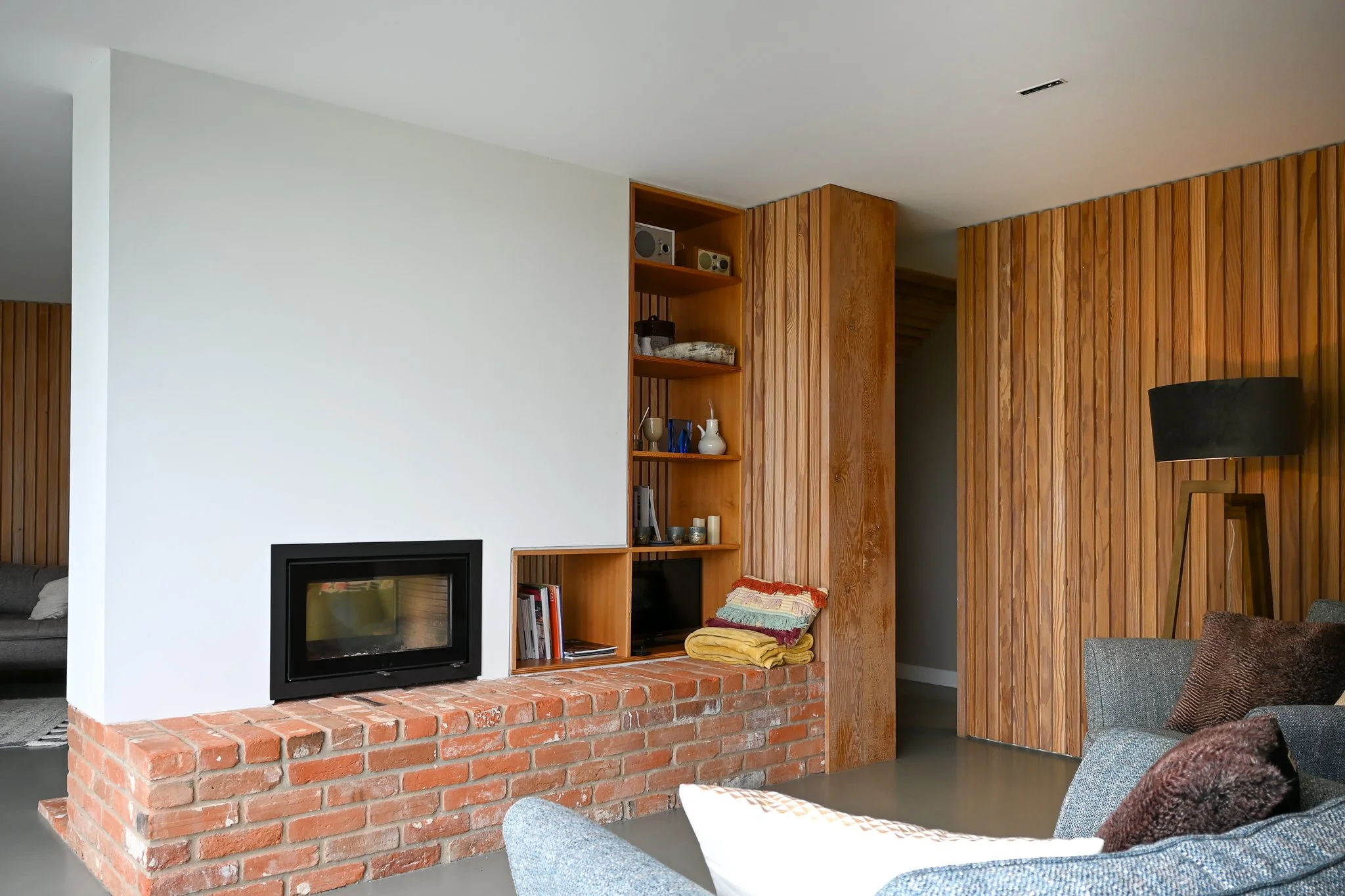
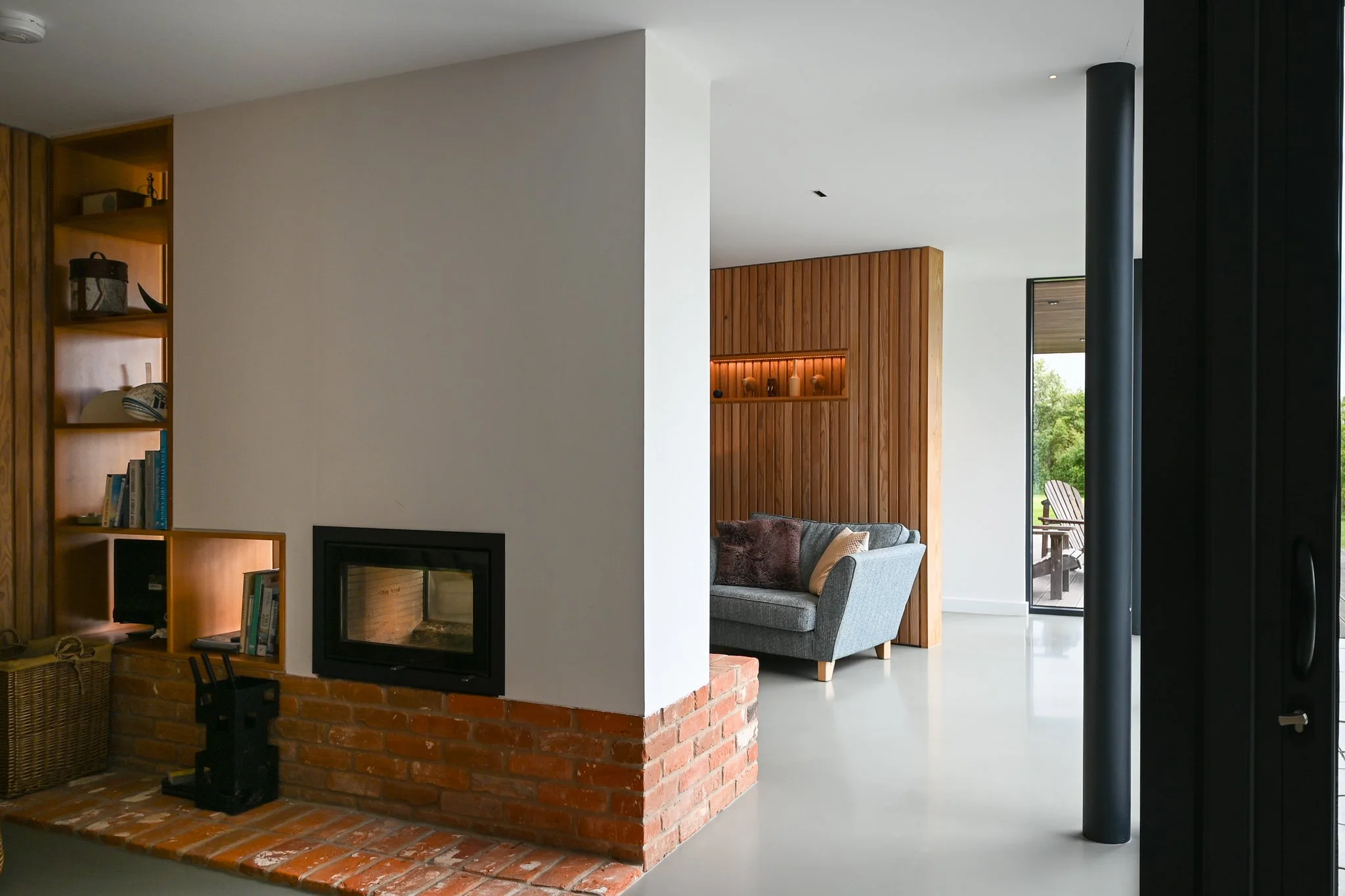
Moving through from the kitchen, the living room has a quieter, warmer character. A Douglas fir surround — "brought in for warmth, to aid with the acoustics and the colors" — wraps the space and provides a deliberate contrast to the more open kitchen and dining volumes. At its centre, a double-sided wood burner feeds both the living room and the snug beyond, drawing heat and atmosphere through both spaces. The snug, slightly more enclosed, provides the most private retreat on the ground floor.
The Courtyard: Hot Tub, Pizza Oven and a Hit-and-Miss Wall
The courtyard, accessed through the mudroom and glazed passage from the kitchen, was one of the more challenging spaces to resolve. "This was a little challenging — what to do with it, and I'm still not sure I'm entirely happy." It has been planted and equipped with a hot tub and a pizza oven, and the original hit-and-miss timber screen — now a defining feature of the courtyard elevation — provides shelter from the prevailing south-westerly wind. A pizza oven, built from one of the trees felled during the build, continues the project's commitment to using and reusing what the land provides.
A Reclaimed Timber Seat From a Felled Tree
"We've just added in this timber seat — it comes from one of the trees that was felled when we built the house. So we've kind of recycled and reused." It is a small detail, but it is characteristic of the project as a whole: nothing is wasted, and every element has a story.
The Grounds: Landscape, Water and the Long View
Planning the Landscape Around an Ancient Woodland
The wider landscape of the farm has been as carefully considered as the house itself. To the rear, an ancient woodland sits just beyond the boundary, and the planting scheme throughout has been developed with professional artists and landscape designers. "We've spent a lot of time planning the landscape." The result is a setting that feels like a continuation of the countryside rather than a garden appended to a house.
The Pond and Water Management
Visible from the upper floor and from multiple points around the house, the large pond is not merely decorative. "The rain water pipes through to this sunken garden — it captures the water from the fields." The whole system has been designed to manage the flow of rainwater from the farm's fields, channelling it through the sunken garden and eventually into the drainage ditch beyond. It is infrastructure that doubles as landscape.
The Sunken Garden and Fire Pit
Slightly removed from the house — deliberately so — the sunken garden sits below the level of the surrounding land, creating an enclosed, sheltered outdoor room. "We wanted to have somewhere which was a little bit below the surface of the ground, to help with the flow of water." Moroccan stone mosaics, built from reclaimed materials, are embedded throughout. A fire pit makes it a destination for the beginning or end of the day. "You can sit here, watch the water animals, and have a fire next to it."
Ash Dieback and the Responsibilities of Stewardship
One of the most significant ongoing challenges at Waterloo Farm has nothing to do with the building. The ash trees that frame the site — a row that Andy describes as "this beautiful ash sward which extends along the drive" — are dying from ash dieback. "The next part of the project is to work out what to replace them with. And I think that's just the nature of this type of project — you don't finish. The responsibilities are much greater than once the building is finished to be built."
The Master Bedroom, Staircase and First Floor
The Master Bedroom: Windows on Three Sides
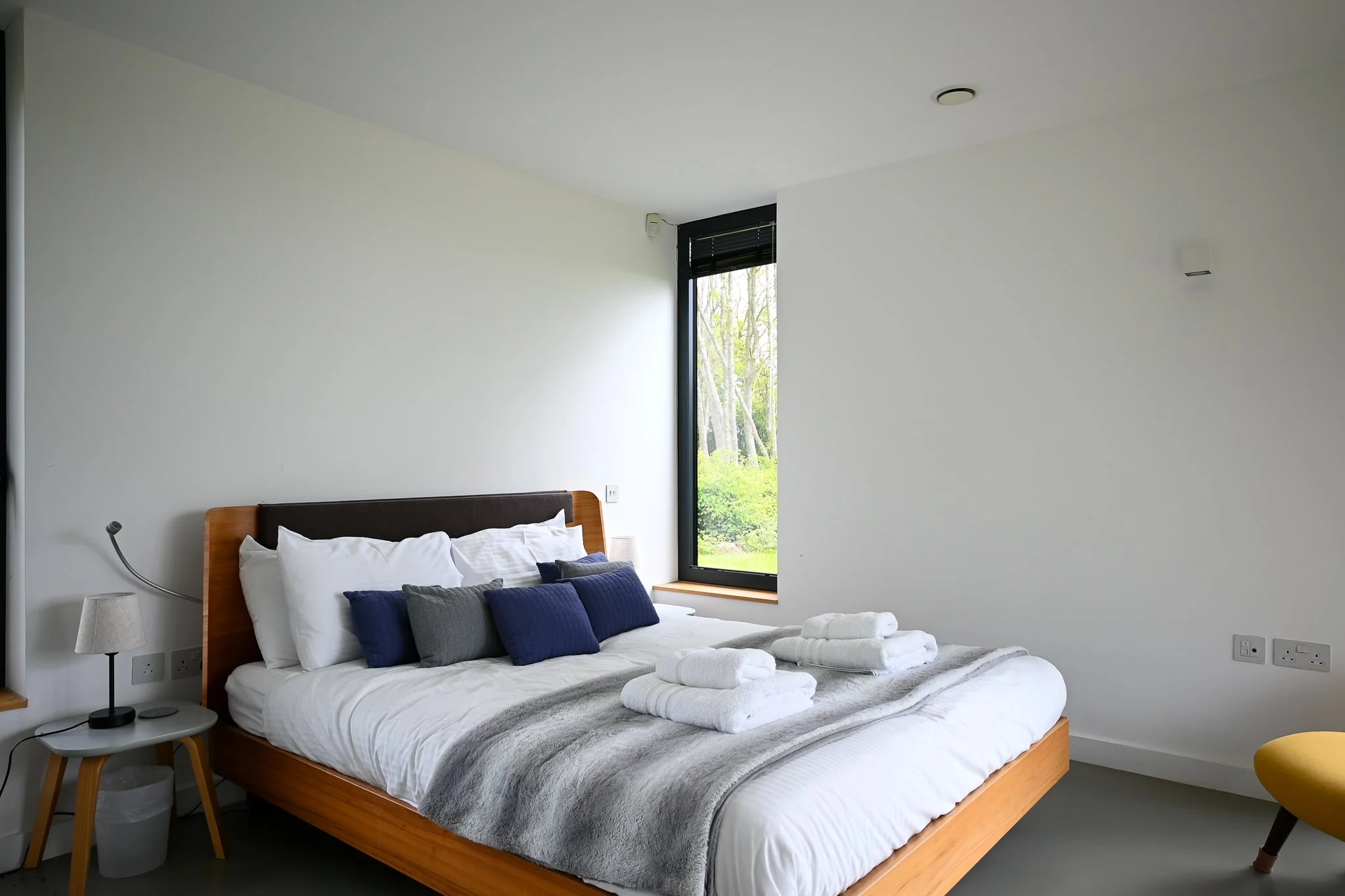
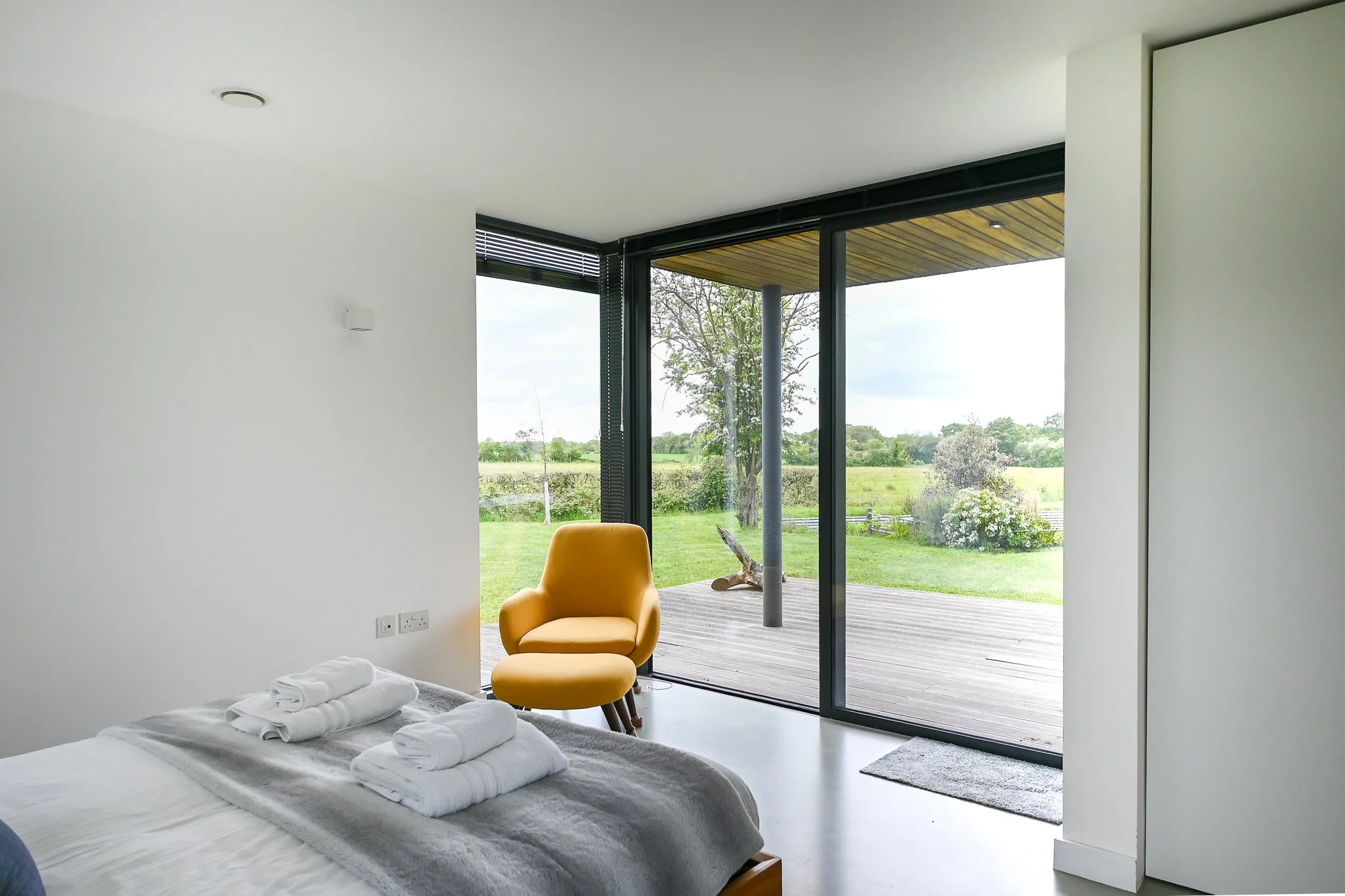
The master bedroom is described by Andy as the favourite room in the house without hesitation. Set at the end of the ground floor, it has windows on three sides, with a private terrace patio just outside. "You are not overlooked in any aspect of this — in the morning, you simply don't need to lower the blinds. And you can really feel the life and nature happening around you." It is a room designed for an intimate relationship with the landscape that the project has spent so much effort to preserve.
The En-Suite Steam Room
Off the master bedroom, the en-suite is not a conventional bathroom. "It's a hammam steam room — it's really a wonderful addition to the house." It is the kind of decision that a decade-long project affords — time to consider not just what a room needs to function, but what it might offer beyond function.
The Staircase: A Near Miss
The staircase has its own story. Midway through the build, Andy was concerned about finances and went to his designer asking where costs could be reduced. The staircase was one of the candidates for simplification. "I put a price tag on this staircase and I said I was thinking of coming up with a simpler, easier design — and she said, 'absolutely anything but.' And I knew at that stage she was right." The staircase that was built is one of the key spatial moments of the house.
The Suffolk Red Brick Wall and the Inside-Out Principle
Carrying the Outside In
One of the most powerful architectural ideas in the house is what Andy calls the inside-out wall — a run of original Suffolk red brick from the old Flemish barn that travels from outside the building to inside, passing through the glazed entrance hall and continuing into the living spaces beyond. "You see the brick work outside, you see the old bricks from the old Flemish barn brought into the house. Suffolk red, as they're known."
Understanding the Design
Andy admits he did not fully understand this element when he first saw it in the drawings. "I'm not an architect and I didn't really appreciate — when I looked at the first design of the wall, I couldn't see what it was there to do other than support the side of the building." It was only as the building went up and the brick wall began to read as a continuous thread connecting exterior to interior, old to new, that its significance became clear. "I suddenly realised how it was going to work. They sit perfectly in the space — it's part of the building, and that's the most important thing."


Upstairs Bedrooms and the Mechanics of the House
Five Double Bedrooms, All with Views
The upper floor contains four of the five double bedrooms, all of which share the same defining characteristic as the rooms below: the landscape is the principal view. "The major focal point for the rooms is still the garden and the fields and the ponds." All rooms have fitted storage concealed within the walls — "no handles, which makes quite a big difference in the space" — and the house-wide ethernet system means that every room has a wired connection, not just wifi.
Ground Source Heating Buried in the Field
The heating system is one of the most significant technical aspects of the project. Ground source pipes run beneath the fields in front of the house, providing underfloor heating throughout the ground floor and hot water for the whole building. Today the system runs extremely effectively and forms part of a broader low-energy strategy that includes solar panels on the roof and heat recovery ventilation units at both ends of the house.
Heat Recovery, Fire Suppression and Ethernet Throughout
"The size and shape of the house means we have two different heat recovery systems — one at this end of the house and one in the other." A full fire suppression system has been installed throughout. Every room has its own ethernet connection. These decisions, made during the build, represent the kind of mechanical investment that pays dividends over decades of occupation and that is almost impossible to retrofit later.

A Home Built on Time, Vision and 14 Acres of Suffolk
The Chatterbox is the product of something increasingly rare in residential architecture: the luxury of time. Three years to decide where to build. A decade to realise the vision. A designer trusted enough to push back on a cost cut that would have diminished the staircase. A client willing to listen, and willing to let the building be what it needed to be.
What Andy has built is not just a house. It is a framework for a relationship with a piece of land — a working farmstead that will continue to evolve, to present new challenges, and to reward the commitment he has invested in it. The ash dieback is the next chapter. There will be others. That, as Andy says, is simply the nature of this type of project.
Project Info
Location: Southwold, Suffolk
Website: The Chatterbox
Designer: Toni Moses Design
Filmed & Produced by: HomeInspire
Written by Dan Burge | Founder of HomeInspire
Share This Story
Get in touch if you’d like to be featured on HomeInspire.
FAQs - Contemporary Self-Build Homes
-
A project of this complexity — involving multiple historic structures, ground source heating, a bespoke kitchen, and extensive landscaping across 14 acres — should be planned over a minimum of five to seven years, though Andy's project took closer to ten. Much of that time was spent in the pre-design phase: living on the land, understanding the site, and deciding where and how to build. That investment of time is reflected in the quality and coherence of the finished project.
-
Generally, yes. Agricultural land does not automatically carry permission for residential development. In Andy's case, a planning permission for a replacement dwelling already existed on the site when he purchased it, which provided a starting point. The specific design and location were then developed in consultation with the local planning authority. If you are considering purchasing a rural site with development ambitions, always verify the planning position before exchange.
-
Ground source heat pumps extract thermal energy from the ground via a series of pipes buried horizontally (at around one metre depth) or in vertical boreholes. In Andy's case, horizontal pipes run beneath the fields adjacent to the house. The system provides underfloor heating throughout the ground floor and hot water for the building. Running costs are significantly lower than gas or oil alternatives, and the system produces no on-site carbon emissions. The upfront cost is higher than conventional heating, but for a self-build on a rural site where mains gas is unavailable, it is almost always the right long-term decision.
-
Andy's approach was to find someone whose portfolio he genuinely admired, and then test whether the working relationship — in his case, conducted largely remotely from Europe — could sustain the demands of a long and complex project. The quality of the designer-client relationship matters as much as the designer's technical ability. Look for someone who will push back when they know they are right, as Andy's designer did over the staircase, and who will commit to the project for its full duration.
-
Andy's advice is direct: install the best systems you can while the building is under construction, because retrofitting is always more disruptive and more expensive. In The Chatterbox, that meant ground source underfloor heating, heat recovery ventilation, a full fire suppression system, ethernet in every room, and a water softener. None of these would have been straightforward to add after occupation. The upfront investment in mechanical quality is one of the few decisions in a self-build that almost never needs to be revisited.


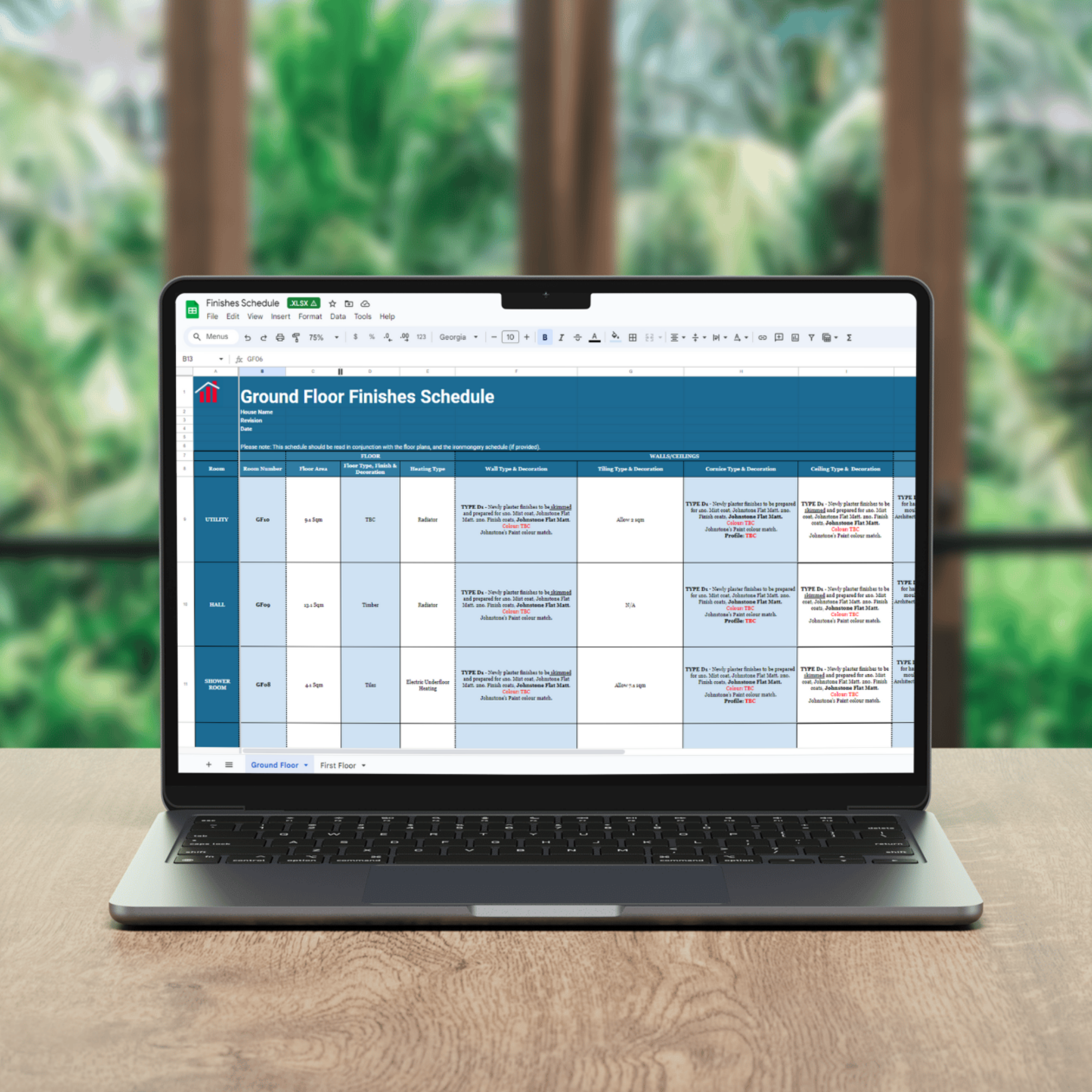
The Ultimate Home Renovation Planner is an all-in-one tool to estimate costs, track progress, and manage every detail of your renovation. Designed by a UK architect, this downloadable Google Sheet includes nine structured tabs to help you stay organised, compare builder quotes, and budget effectively.