
The Old Mission Church: The Contemporary Conversion of an 1860s Heritage Church in the Cotswolds.
Produced & Written by Dan Burge | 04 April 2026
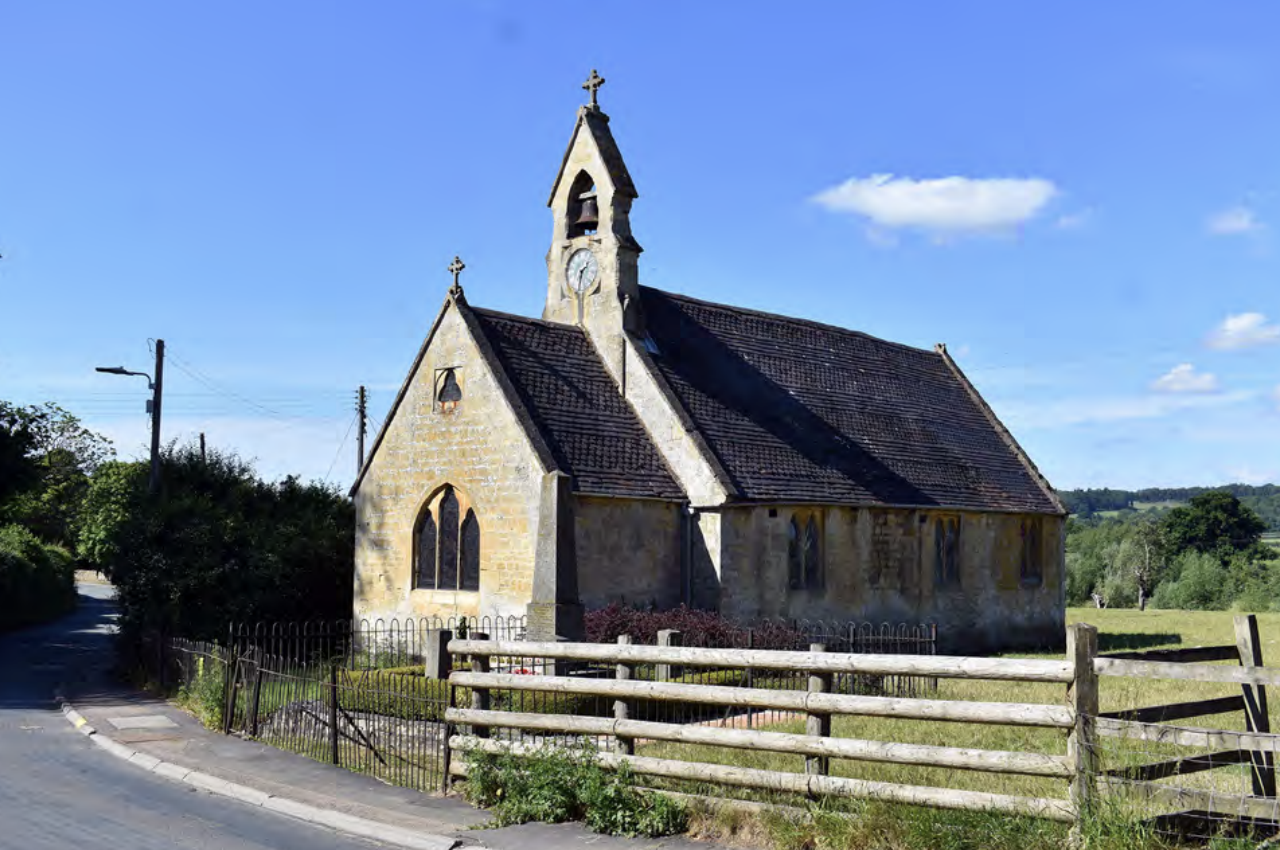
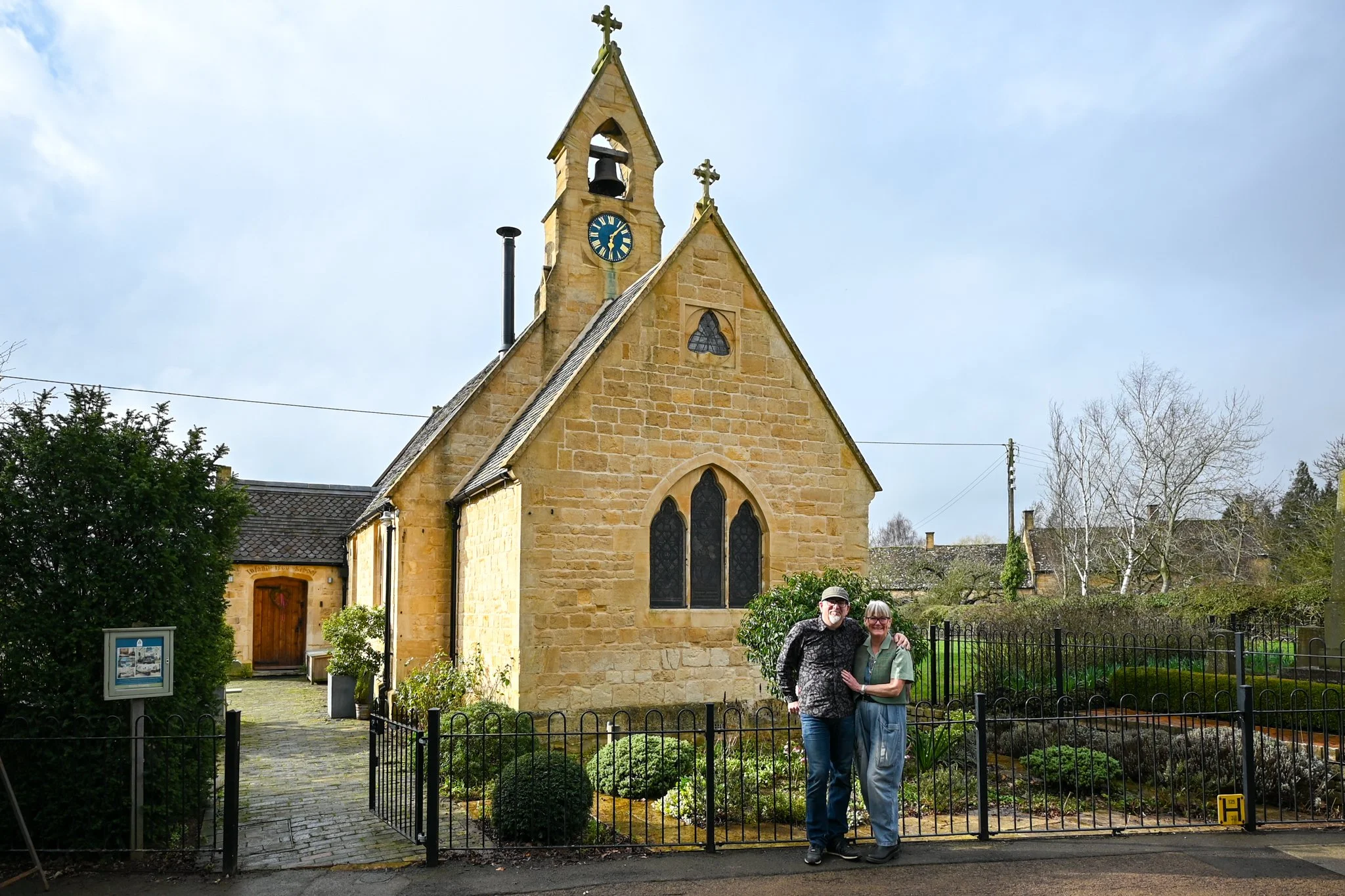
We were invited by Geoff and his wife Julie to film and feature their conversion of a Victorian mission church in the village of Paxford, Gloucestershire. Having purchased the grade II unlisted heritage building in 2021, the couple spent three and a half years - including two years navigating design and planning - transforming this 1866 stone church into an award-winning two-bedroom holiday let.
In this HomeInspire project tour, we take you inside one of the most considered heritage conversions we've had the pleasure of filming: a building that presented challenge after challenge, and yet yielded something genuinely extraordinary.
"It was quite an adventure," Geoff reflects, "but we had a lot of fun along the way as well."
From Mission Church to Cotswolds Holiday Let
A Village Building with Two Lives
The Old Mission Church was built in 1866 as a school for local children — but within a year, it had been licensed by the Bishop of Worcester to serve double duty as a place of worship. There was no church in the village at the time, and the building quietly took on both roles.
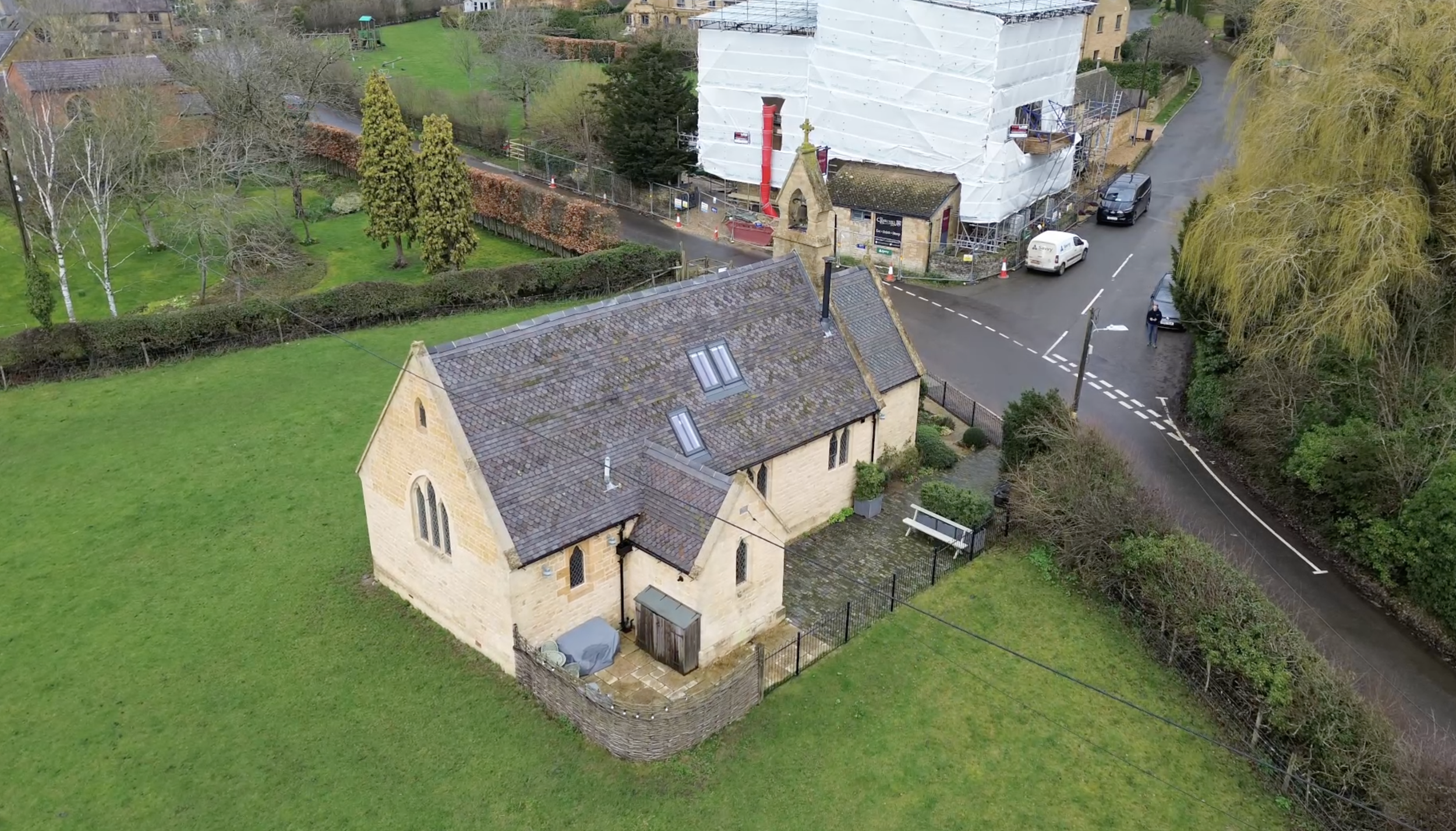
Legislation eventually required that schooling and worship be separated, prompting an extension at the rear of the building - the former school room - connected to the nave by a wide archway and a pair of original timber doors. That layered history, written into the very fabric of the building, would go on to shape almost every design decision Geoff and Julie made.
A Leap in the Dark
Geoff, who spent many years as a designer running his own business in London, had always harboured an interest in heritage buildings. But buying a church was a different proposition altogether. He and Julie were already familiar with the area, having owned a holiday home in Paxford since 2013, and as they began planning for retirement, they were looking to invest the proceeds from their London house sale.
"We hadn't thought about buying the church," he explains, "although it was on the market. It wasn't until a friend of ours suggested perhaps we look at it that we came and had a quick look around — and it actually suited our needs really well."
The church was offered by closed bids, with offers above £100,000 invited. Fourteen bids were submitted. Geoff and Julie's bid of £175,000 — submitted alongside sketch plans — won by a narrow margin.
Uncovering the Unexpected
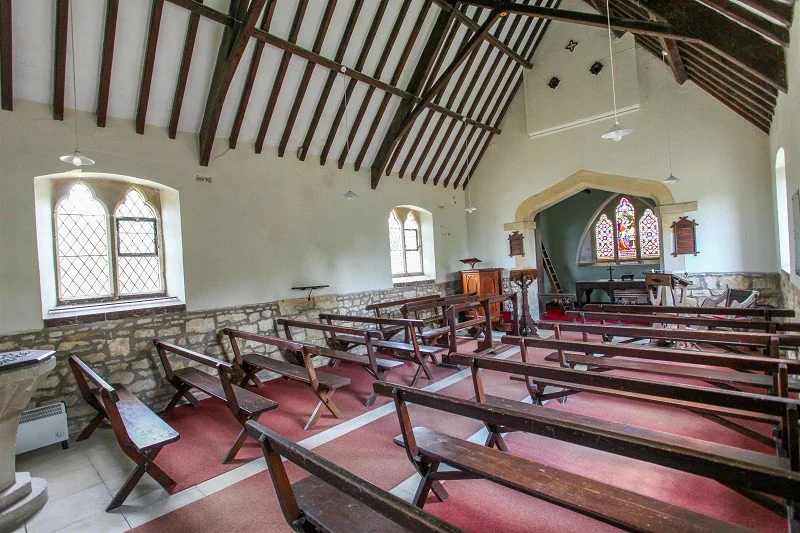
What appeared from the outside to be a building in reasonably good condition revealed itself quickly as something far more complex. The concrete floor was forcing damp into the walls. The walls themselves had been repointed with cement, trapping moisture rather than allowing it to breathe. Dark varnish covered what turned out to be beautiful pitch pine throughout the doors and ceiling beams.
"Generally our process was to remove any modern materials," Geoff explains, "and replace everything with natural lime products which allow the walls to breathe."
The limecrete floor replacement, full repointing in lime, and specialist shot blasting of the woodwork became the first wave of works — before the structural problems had even been discovered.
Designing Around the Space
Changing Direction on Architecture
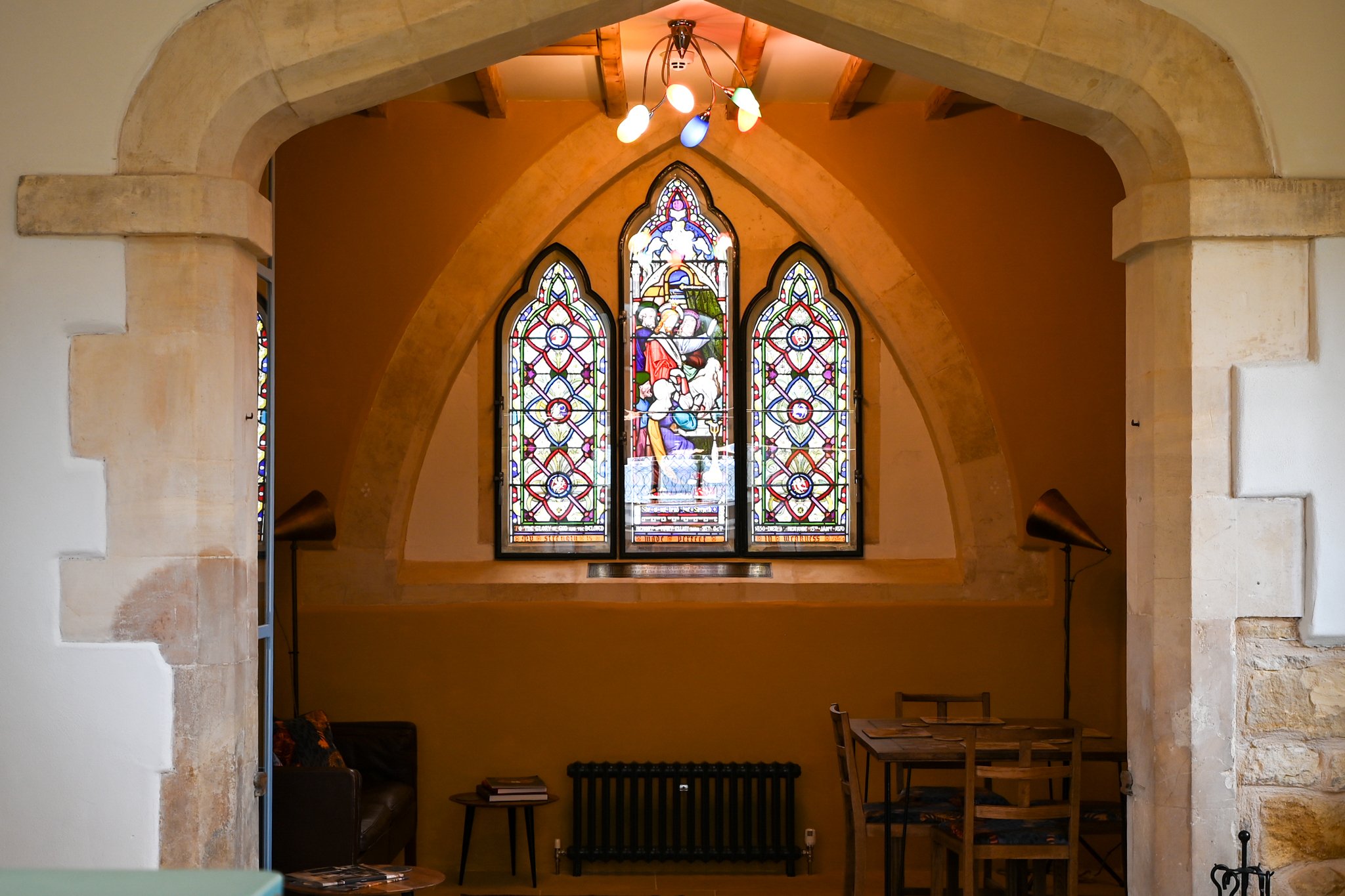
Geoff and Julie initially appointed a local architect, who proposed placing the bedroom in the chancel — the east end beneath the stained glass window — with the kitchen in the former school room at the rear. To create a bedroom large enough to include an en suite, however, a partition would have had to cut across the nave, severing the visual connection to the stained glass.
It was the conservation officer who intervened. "She commented that she thought subdividing the room would be a mistake," Geoff recalls, "and that we should try and retain the sense of space — and in particular, as you walk in the door, she felt it would be wrong to not be able to see right through the volume to the stained glass window."
The decision was made to change architects entirely, appointing a practice with greater experience in heritage conversions. The result was a fundamentally different scheme.
The Pod Concept
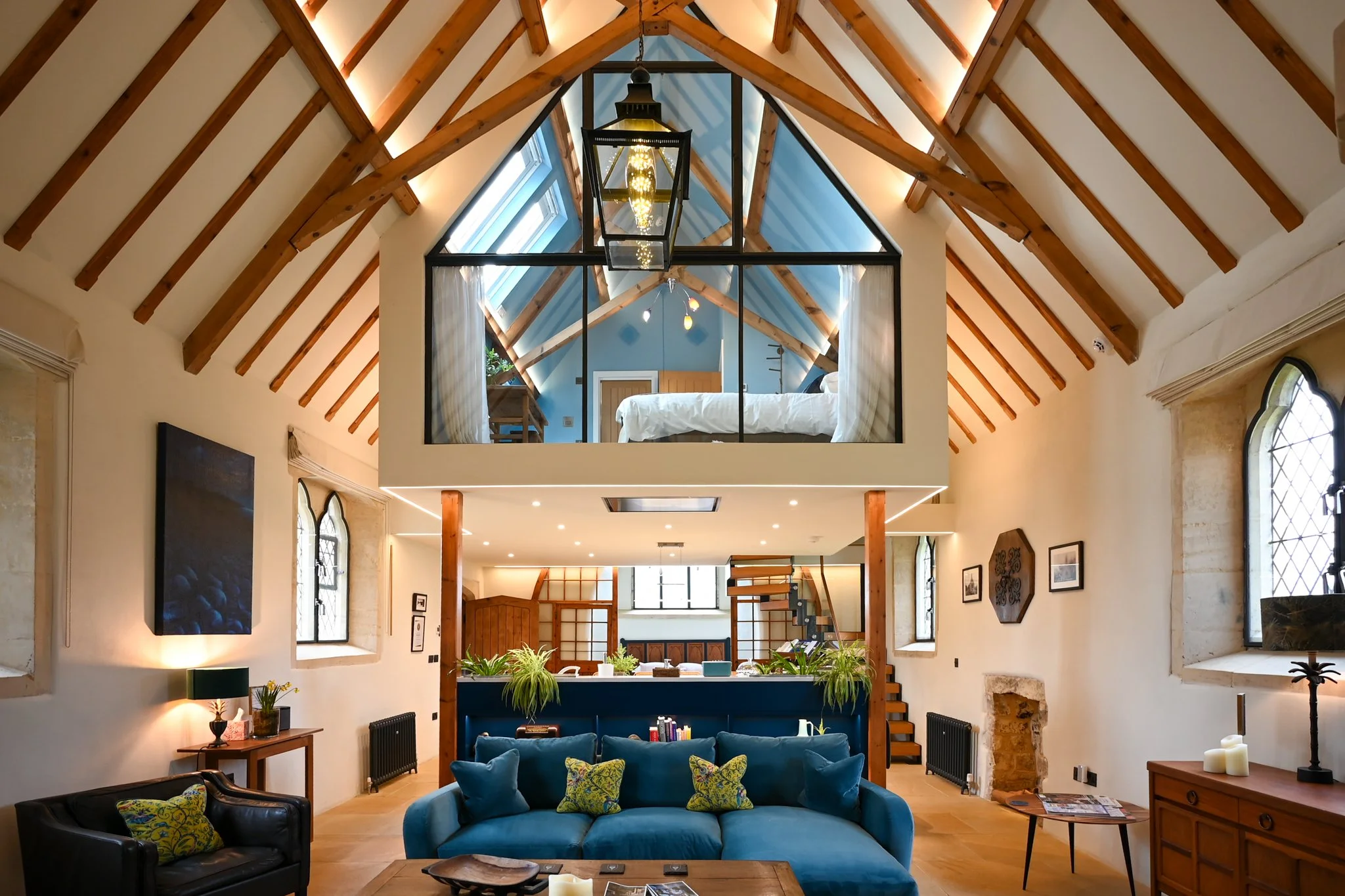
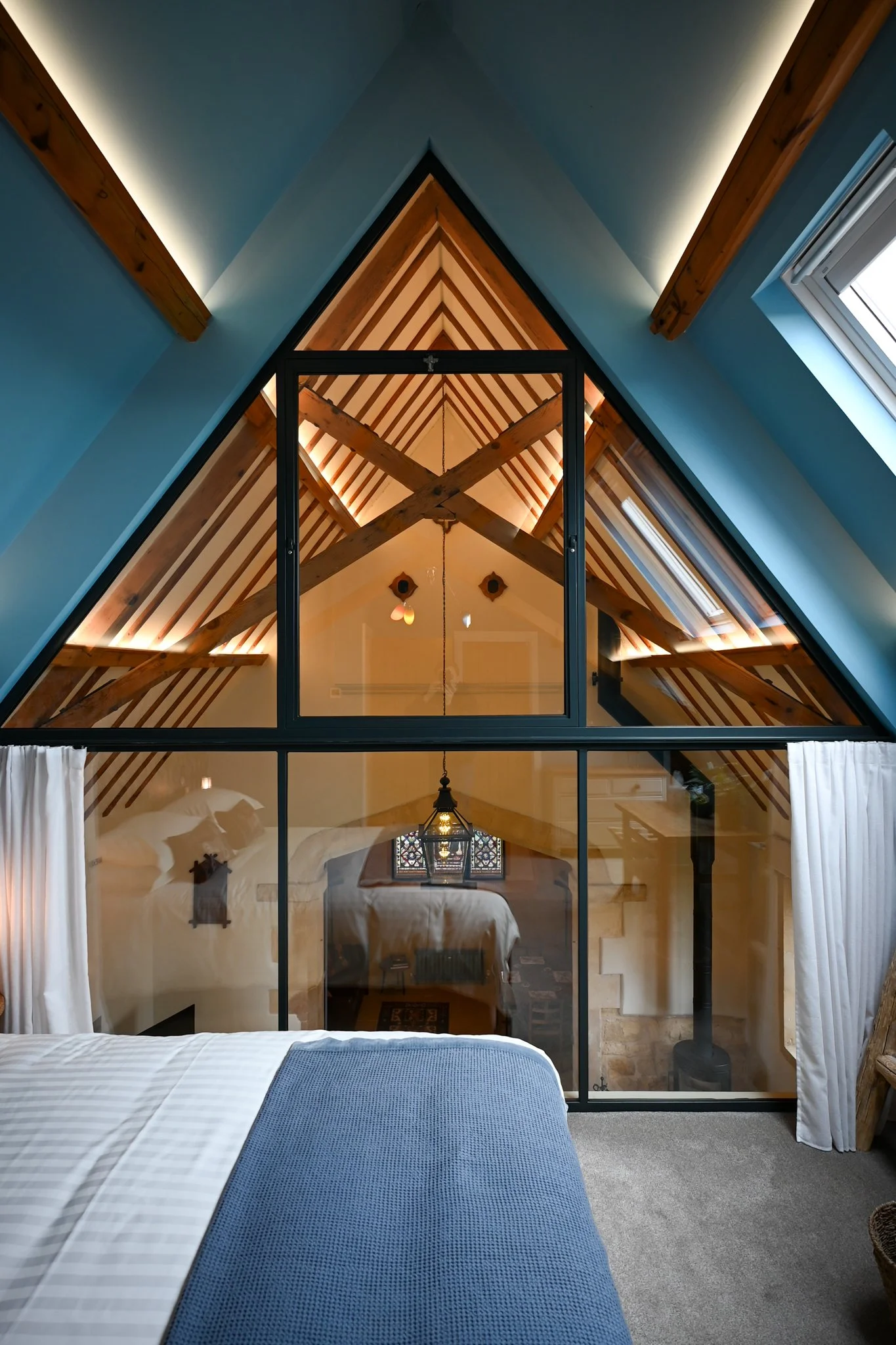
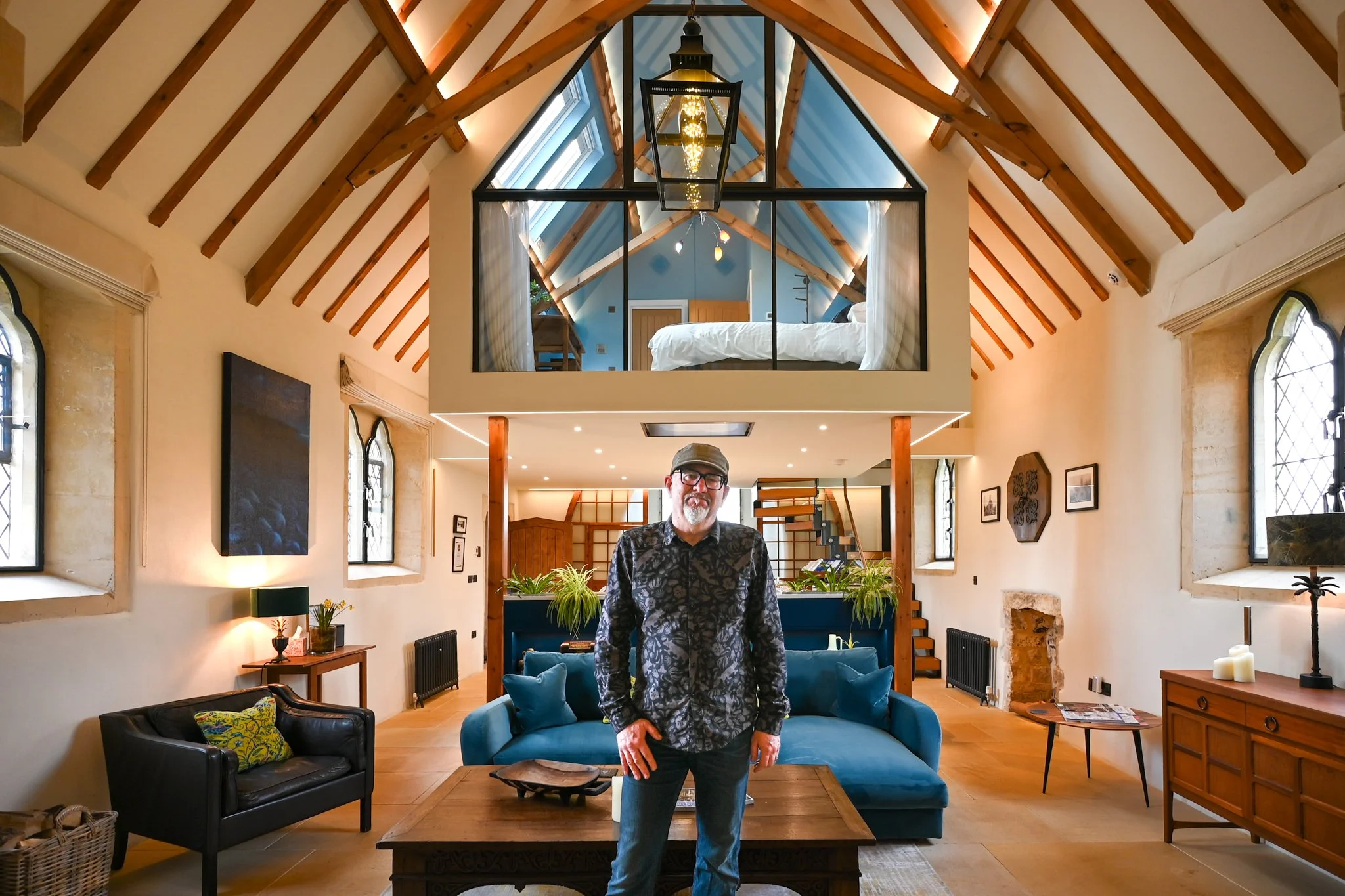
The new design flipped the layout: the kitchen moved into the nave, and the former school room became the ground-floor bedroom. The masterstroke, however, was the treatment of the upper bedroom. Rather than installing a full mezzanine floor — which would have compromised the full-height space — the architects proposed a freestanding pod structure, suspended on four steels within the nave.
"It works on a number of different levels," Geoff explains. "Partly because it's quite low intervention. If at some point in the future it needs to be removed, it's simply a case of taking out four steels. But also architecturally, it means you can have a modern design which doesn't look incongruous in a heritage building."
The pod sits above the kitchen zone, its glazed front screen — double-glazed for sound insulation — overlooking the nave below. It is at once clearly contemporary and completely at home within the Victorian stone shell.
Retaining the Full Height
With two bedrooms — one up, one down — Geoff and Julie made a deliberate choice to forgo what could have been three. A full mezzanine across the entire nave would have allowed for more sleeping accommodation, but it would have destroyed the spatial drama that makes the building exceptional.
"We were happy to have two bedrooms in total in order to retain the full height," Geoff says simply. It is a decision that defines the entire character of the conversion.
Navigating Heritage Constraints
Working with the Conservation Officer
Throughout the project, the local conservation officer played a significant and largely constructive role. The church was classified as a non-listed heritage asset — giving the team somewhat more latitude internally than a listed building would have allowed — but the planners were nonetheless closely involved in several key decisions.
The log-burning stove, originally intended for the chancel, had to be relocated to the nave after concerns were raised about a flue protruding through the front roof slope. The compromise — cranking the flue so the chimney emerges further back on the secondary roof plane, less visible from the road — is almost imperceptible from the outside.
The conservation officer also weighed in on the clock weights. Geoff had investigated replacing the mechanical clock drive with an electric winding mechanism, which would have allowed the visible pendulum weights to be removed. "The conservation officer felt it would be better to retain the clock weights because they tell the story of the church." The solution was an elegant glass cabinet, purpose-built to house the running weights — functional, visible, and entirely in keeping.
The Roof Crisis
One of the most significant — and costly — discoveries came when the roof tiles were lifted. What appeared to be a straightforward repair job revealed that the battens holding the tiles were nailed directly to the laths supporting the plaster ceiling, and were almost entirely rotten.
"It wasn't possible to take the tiles off the roof without disturbing the plaster," Geoff explains. "So quite a big decision was made early on that in order to fix the ceiling, we'd actually have to re-roof the whole property."
The existing tiles had no nail holes — fixed in the traditional manner using lime mortar torching from beneath. Rather than replace them, the team cut slots into the sides of the tiles with an angle grinder, allowing almost all the original tiles to be reused, supplemented with carefully sourced reclaimed matching tiles.
The ceiling itself is now a false construction: plasterboard skin with recreated false beams, concealing approximately 150mm of new insulation above.
Secondary Glazing and the Stained Glass
The stained glass window — a defining feature of the chancel — was removed entirely during the works, taken off site for careful restoration, and reinstalled as one of the final acts of the build. Several panes had been damaged by stones thrown up from lawn mowing; all were repaired by a specialist.
On heat loss, the first architect had recommended replacing the windows with double glazing — a proposal the heritage architect firmly set aside. Instead, bespoke secondary glazing frames were fabricated, following the profile of the original windows and fitted with argon-filled double-glazed units. "You can negotiate with building regulations if you're doing a heritage project," Geoff notes — and the result preserves the external character of the building entirely.
Related Articles
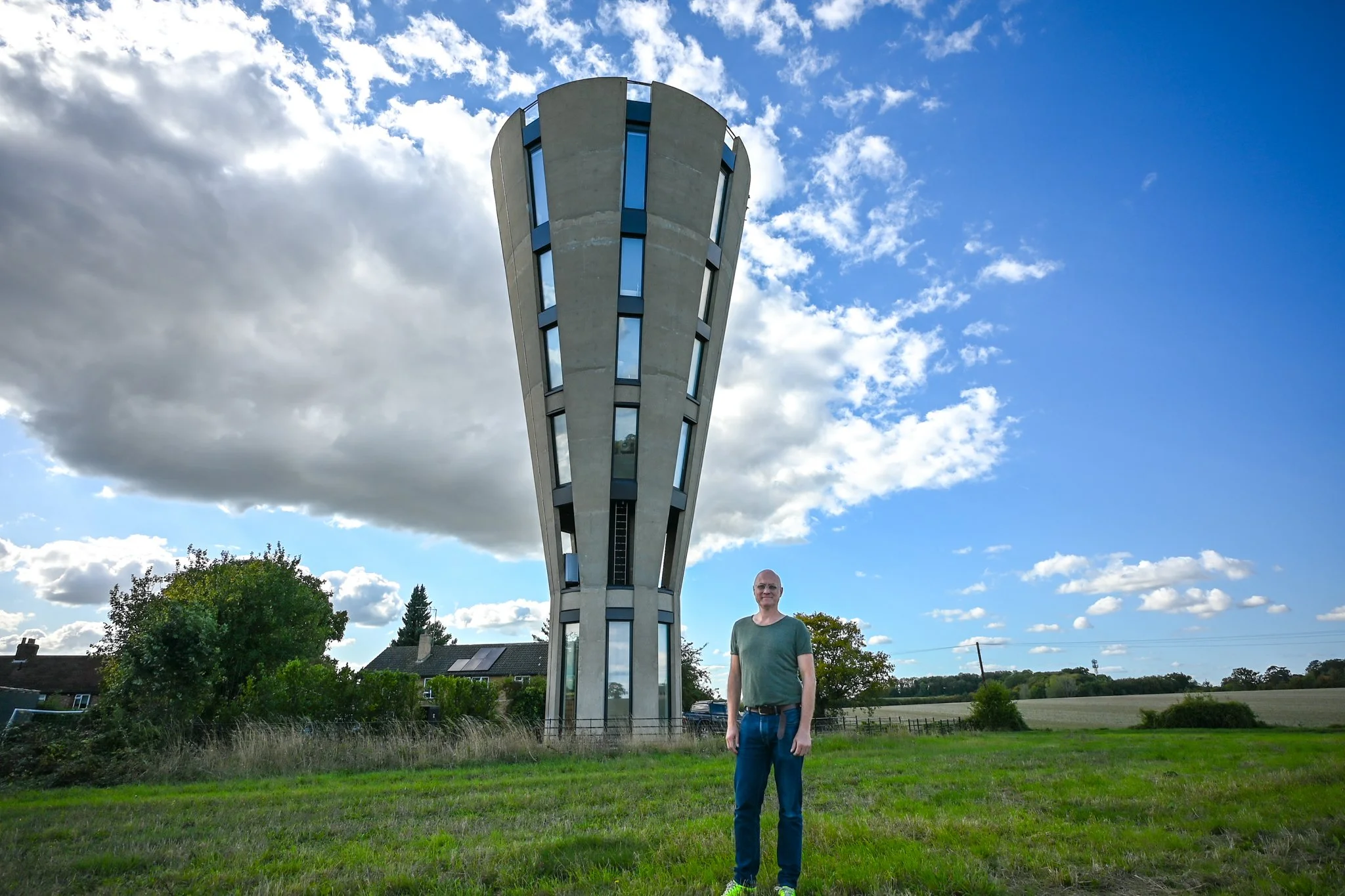
Tonwell Tower: A Conversion of a 1960s Brutalist Water Tower into a Family Home in Hertfordshire.
The Warehouse: A 19th-Century Converted Edwardian Warehouse in the Heart of Central London.
Copeland Road: A Reimagined Victorian Terrace Featuring an Innovative Three-Storey Timber Extension.
Craft, Detail, and Interior Decisions
Materials and Finishing
With the lime works complete, attention turned to the interior surfaces. A neighbour's recommendation led Geoff and Julie to a product called Diathonite — an insulating internal plaster comprising approximately 50% cork, with lime and aggregates making up the rest. Applied by spray to around 40–50mm depth and finished with a fine surface aggregate, it provides the building's distinctive subtly textured internal walls while contributing meaningfully to the thermal performance.
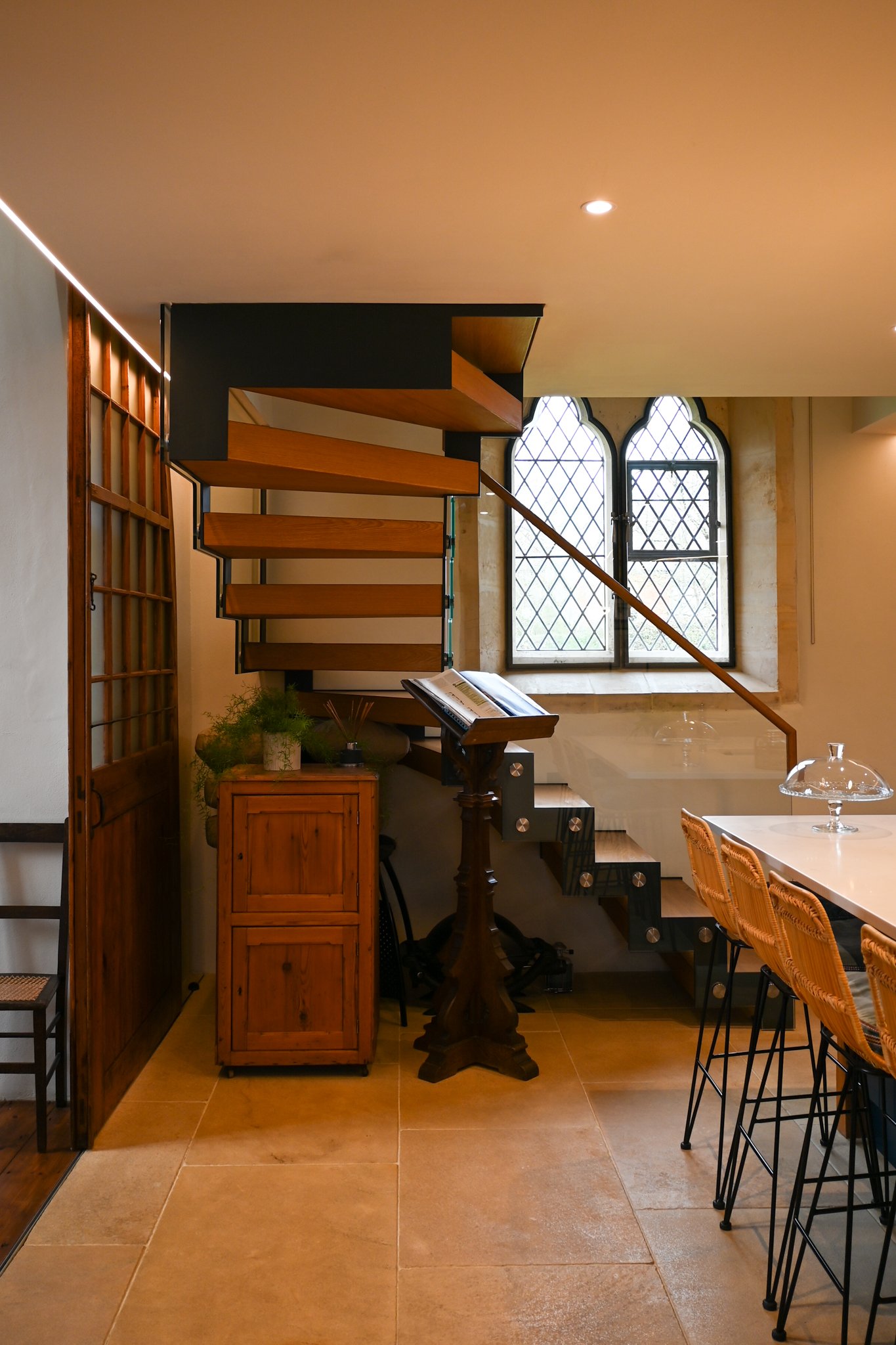
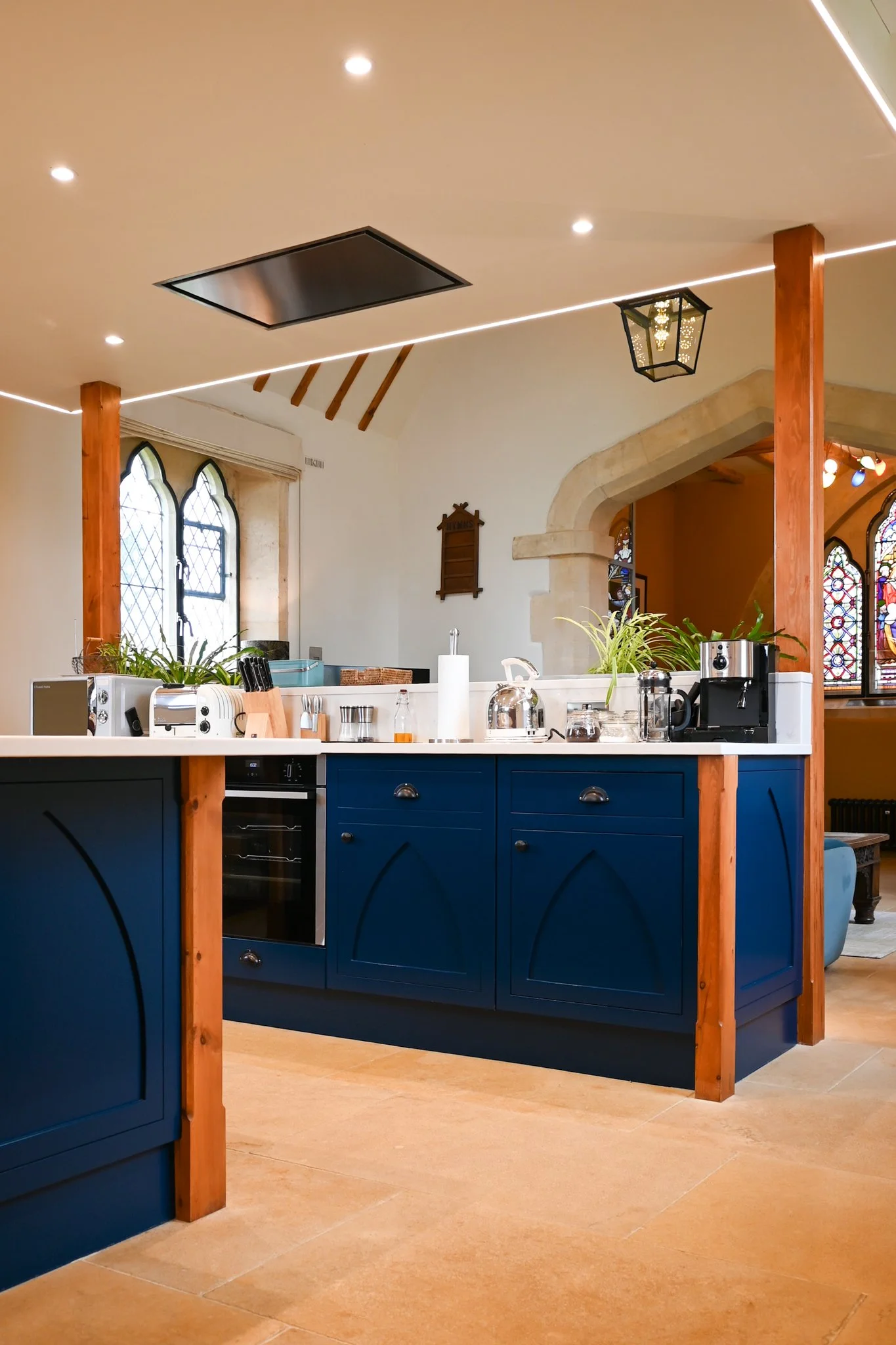
The steel beams supporting the pod were clad in reclaimed pitch pine, matching the revealed timber of the original ceiling beams and the posts framing the kitchen and breakfast bar. The kitchen itself was made by a friend of the couple — a bespoke piece designed with arched cabinet fronts that echo the church's own geometry, finished in a blue that was colour-matched directly to the restored clock mechanism found within the building.
"When we restored the clock we found it probably was originally blue," Geoff explains. "So the clock is colour-matched to the kitchen — it ties through."
The Bedrooms
The ground-floor bedroom occupies the former school room, a more compact space whose constraints were met with careful planning. The bathroom specification began with a decision on shower tray size — 1000mm — with everything else designed outward from that. Pocket doors were installed throughout to save space without compromise.
A freestanding resin bathtub, imported from Italy and placed within the bedroom itself rather than the en suite, adds a quiet sense of luxury. The headboard is fashioned from the panels of the original pulpit — repurposed rather than discarded.
The pod bedroom above mirrors much of the lower bathroom's specification. Both bedrooms share a consistent palette that responds to the building: cherry-toned pitch pine, a warm blue, and the layered textures of lime plaster and reclaimed timber.
HomeInspire Downloads
Download Our Complete Renovation Handbook
A step-by-step guide to planning, designing, and delivering your dream home.
Planning your first renovation doesn’t have to be overwhelming. This 62-page step-by-step eBook guides you through every stage - from budgeting and planning to design, permissions, and finishing touches. Packed with expert advice, checklists, and cost guides, it helps you avoid mistakes, stay on track, and bring your dream home to life.
Fire Safety and Ventilation
In an open-plan space with a mezzanine and a single staircase, fire safety required careful resolution. Rather than enclose the kitchen or staircase, Geoff and Julie opted for an Automist system — an infrared-triggered suppression system that fires a fine mist of water vapour directly at a detected fire source. "We were surprised it wasn't that expensive to install," Geoff reflects.
Ventilation, too, required an inventive approach. The thickness of the stone walls made conventional mechanical ventilation disproportionately costly to run through the building. The solution was to modify the existing window openers, roughly doubling the ventilation aperture, and to introduce trickle ventilation settings on both the primary and secondary glazing.
The Finished Building
A Project That Gave Back
The total cost of the conversion came in at approximately £370,000 — well above the initial estimate of around £110,000, and significantly above the revised architectural estimate of £170,000–£200,000. Structural works, re-roofing, full replastering, drainage, services, and professional fees all contributed to the final figure.
"With a project on an old building, you have to expect the unexpected," Geoff says. "It's really important to have a significant contingency budget put aside."
The project took three and a half years in total: the best part of two years through design and planning — including pre-application planning, which Geoff recommends — and fourteen months for the build.
Recognition and Life as a Holiday Let
The Old Mission Church now operates as a holiday let, bookable through the couple's own website. In 2025, it was named Muddy Stilettos' best boutique stay, reaching the national top five for the UK.
"We're very proud of what we created here," Geoff says. "It was a big learning curve and quite an adventure."
Project Info
Location: Paxford, Gloucestershire
Website: theoldmissionchurch.com
James Mackintosh Architects: www.jamesmackintosharchitects.com
NJN Design and Build Ltd: www.njndesignandbuild.com
Diathonite Evolution insulating plaster: www.diasen.com/en/diathonite-evolution/
Lime Green: www.lime-green.co.uk
Automist Smartscan fire suppression: www.plumis.co.uk/smartscan
Jordaya Contracting: www.jordayacontracting.co.uk
Ty-Mawr: www.lime.org.uk/
Filmed & Produced by HomeInspire
Photography by InspireMedia
Written by Dan Burge | Founder of HomeInspire
Share This Story
Get in touch if you’d like to be featured on HomeInspire.
FAQs – Heritage Conversions
-
The total cost of the conversion came in at approximately £370,000, including landscaping. This was significantly higher than the initial estimate of around £110,000, and above a revised architectural estimate of £170,000–£200,000. The increase was driven by a series of unforeseen structural issues, including a full floor replacement, complete re-roofing, lime replastering throughout, new drainage, and full electrical and water supplies — alongside architect and professional fees.
-
The project took around three and a half years in total — approximately two years working through design and pre-application planning, followed by fourteen months of construction. Jeff recommends undertaking pre-planning before submitting a formal application, particularly on heritage projects where conservation officer input can significantly shape the design direction.
-
Not necessarily. The Old Mission Church was treated as a non-listed heritage asset rather than a listed building, which gave the owners somewhat more flexibility — particularly with the interior. However, a conservation officer was still closely involved throughout the process, influencing decisions on the stained glass, the roof, the log burner flue, and the clock weights. For any heritage conversion, early engagement with the local planning authority and a conservation-experienced architect is strongly advisable.
-
Several strategies were used in combination. The original windows were retained and fitted with bespoke secondary glazing units filled with argon gas, avoiding the need for full replacement. The internal walls were treated with Diathonite, an insulating lime-based plaster containing approximately 50% cork, applied at 40–50mm depth. Underfloor heating was installed throughout using a limecrete screed, and the re-roofed ceiling now contains around 150mm of insulation concealed behind a false plasterboard skin with recreated beams.
-
A mezzanine pod is a freestanding elevated structure — in this case a bedroom — supported on steels within the existing volume of the building, rather than a full floor inserted across the entire space. At The Old Mission Church, the pod solution allowed the architects to introduce an upper bedroom while preserving the full-height nave and the uninterrupted sightline from the entrance through to the stained glass window. It also has the advantage of being reversible: the entire structure could theoretically be removed by taking out just four steel supports.
You May Also Be Interested In:
HomeInspire visited Emilie Mauren of EMR Architecture, and her latest project in Wimbledon, southwest London - a Victorian house that had been split into two dated flats, reworked & converted back into a single family home for a family of four. The brief covered almost every part of the building: a rear extension, a new floor added in the loft, and a garden studio, all threaded together with reinstated Victorian details at the front and a mid-century feel running through the interiors.